Good Writing: An Evening with Anne Lamott & Neal Allen

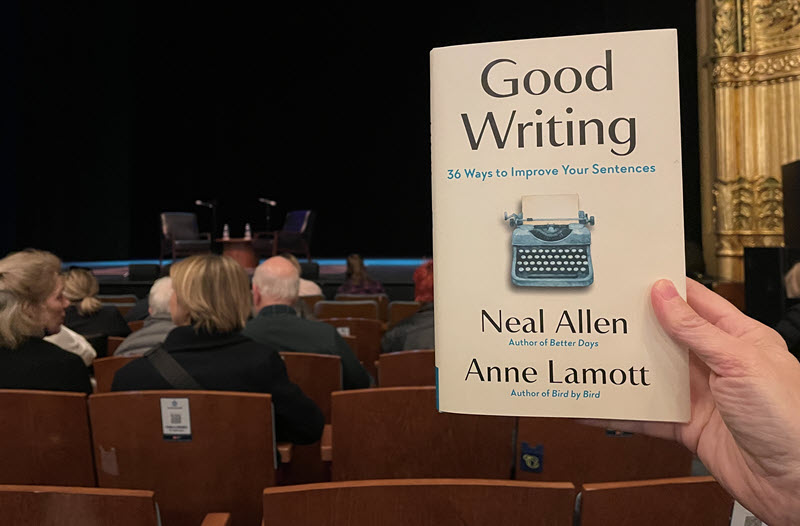
As a 20th wedding anniversary gift, my wife Kate got us tickets to see Anne Lamott and Neal Allen talk about Good Writing: 36 Ways to Improve Your Sentences, which they wrote together. Since Kate and I have published seven books between us, and have aspirations to write more and eventually co-author a novel, we were curious about them as a writing duo. I was also curious about their thoughts on the issues of the day, and since the audience could submit questions, I asked them and was fortunate enough to have them pick my questions.
Social media & book reviews
In response to my question about how social media has changed in the publishing industry, Lamott said, “There are no more book reviews in the world. It’s all social media.”
She added that Good Writing was her 21st book and her first launched with no book reviews. “You have to create a platform.”
That’s sobering advice for every writer who hates social media and platform building.
The role of artificial intelligence
Along with many others, I asked about their views on artificial intelligence. Neither of them was interested in using it for writing, with Lamott joking, “I don’t know how to operate a toaster.” Allen said he wasn’t tempted to use AI for writing because the writing is the part he enjoys. Later, he would say, “It’s only through writing the book that I discover what I don’t know.”
That said, both Allen and Lamott were in awe of AI. It has not only read every novel, said Allen, but all literary criticism. “AI is going to be the authority.”
At times, Lamott sounded downright fatalistic about AI. A Sunday School teacher until recently, she said she asked ChatGPT to write a Palm Sunday talk “in the style of Anne Lamott” and confessed that it was “exquisite.” She concluded, “There’s no reason for me. It can write me.” That statement alarmed the audience.
“I think there will be guilds like there were in the Middle Ages,” added Lamott, who’s concerned about the impact AI will have on her son and grandson. “There will be people huddled together escaping AI.”
The purpose of writing
While that sounds dystopian, both Lamott and Allen see writing as a personal endeavor first, an interpersonal endeavor second, and a community endeavor last. Lamott said the fulfillment is in the writing, not the publishing.
“The respect you’re looking for is only from within,” she said, “and that’s terrible news for people who just got an agent.”
In arguing that it’s about the writing, Lamott went so far as to say, “I’m not going to be remembered.” That also shocked the audience. But she backed it up by rattling off a list of great authors she loves who aren’t read anymore.
The option of self-publishing
However, it was difficult to square those views with others they expressed, particularly when I asked about self-publishing.
“If I was younger, I’d really consider self-publishing,” said Lamott, acknowledging that getting an agent and a publisher is “so hard.”
They shared that Allen self-published a book he wrote that didn’t sel. It went on to sell 3,000 copies, which the audience applauded. Those sales figures put his book solidly among the top 10% of all published books, which is applaud-worthy indeed, even if they aren’t blockbuster sales numbers.
However, he said his agent is currently trying to sell a novel of his, and that he wouldn’t self-publish this one if it didn’t sell. In another surprising turn, he added, “I don’t think the world needs my novel.”
Given his statements about writing for the sake of self-discovery and self-fulfillment, perhaps that makes sense. But it begs the question: If publishing doesn’t matter and the world doesn’t need his novel, then why is he having his agent try to sell it?
For my part, I’m going to pretend he didn’t say that and focus on something else he said instead: “Everyone is yearning for intimacy with the world.”
That rings true to my ears. And that’s why I think self-publishing is such a game-changer. It gives everyone a chance to be heard and to affect others—however fleetingly.
Related posts:
Why are we trying to discourage aspiring novelists from publishing?
Where to draw the line with genAI
To get future posts…
