Good Writing: An Evening with Anne Lamott & Neal Allen

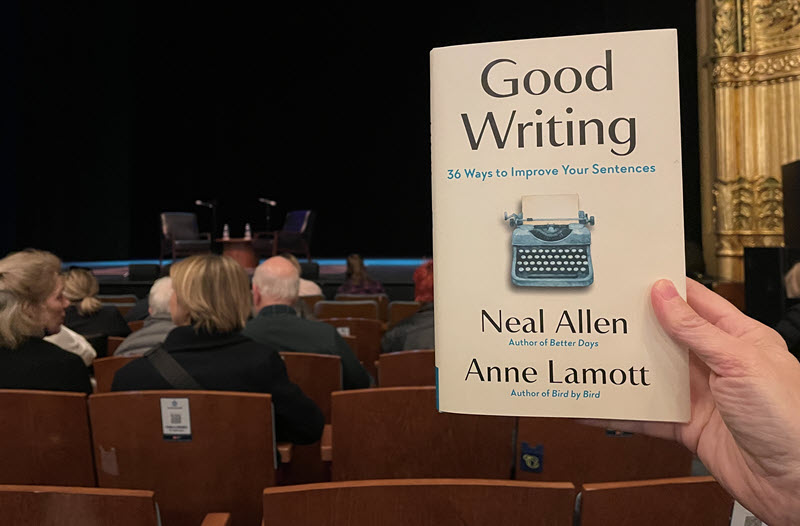
As a 20th wedding anniversary gift, my wife Kate got us tickets to see Anne Lamott and Neal Allen talk about Good Writing: 36 Ways to Improve Your Sentences, which they wrote together. Since Kate and I have published seven books between us, and have aspirations to write more and eventually co-author a novel, we were curious about them as a writing duo. I was also curious about their thoughts on the issues of the day, and since the audience could submit questions, I asked them and was fortunate enough to have them pick my questions.

Moments before Anne Lamott and Neal Allen took the stage to discuss Good Writing and answer audience questions

Social media & book reviews

In response to my question about how social media has changed in the publishing industry, Lamott said, “There are no more book reviews in the world. It’s all social media.”

She added that Good Writing was her 21st book and her first launched with no book reviews. “You have to create a platform.”

That’s sobering advice for every writer who hates social media and platform building.

The role of artificial intelligence

Along with many others, I asked about their views on artificial intelligence. Neither of them was interested in using it for writing, with Lamott joking, “I don’t know how to operate a toaster.” Allen said he wasn’t tempted to use AI for writing because the writing is the part he enjoys. Later, he would say, “It’s only through writing the book that I discover what I don’t know.”

That said, both Allen and Lamott were in awe of AI. It has not only read every novel, said Allen, but all literary criticism. “AI is going to be the authority.”

At times, Lamott sounded downright fatalistic about AI. A Sunday School teacher until recently, she said she asked ChatGPT to write a Palm Sunday talk “in the style of Anne Lamott” and confessed that it was “exquisite.” She concluded, “There’s no reason for me. It can write me.” That statement alarmed the audience.

“I think there will be guilds like there were in the Middle Ages,” added Lamott, who’s concerned about the impact AI will have on her son and grandson. “There will be people huddled together escaping AI.”

The purpose of writing

While that sounds dystopian, both Lamott and Allen see writing as a personal endeavor first, an interpersonal endeavor second, and a community endeavor last. Lamott said the fulfillment is in the writing, not the publishing. 

“The respect you’re looking for is only from within,” she said, “and that’s terrible news for people who just got an agent.”

In arguing that it’s about the writing, Lamott went so far as to say, “I’m not going to be remembered.” That also shocked the audience. But she backed it up by rattling off a list of great authors she loves who aren’t read anymore.

The option of self-publishing

However, it was difficult to square those views with others they expressed, particularly when I asked about self-publishing.  

“If I was younger, I’d really consider self-publishing,” said Lamott, acknowledging that getting an agent and a publisher is “so hard.”

They shared that Allen self-published a book he wrote that didn’t sel. It went on to sell 3,000 copies, which the audience applauded. Those sales figures put his book solidly among the top 10% of all published books, which is applaud-worthy indeed, even if they aren’t blockbuster sales numbers.

However, he said his agent is currently trying to sell a novel of his, and that he wouldn’t self-publish this one if it didn’t sell. In another surprising turn, he added, “I don’t think the world needs my novel.”

Given his statements about writing for the sake of self-discovery and self-fulfillment, perhaps that makes sense. But it begs the question: If publishing doesn’t matter and the world doesn’t need his novel, then why is he having his agent try to sell it?

For my part, I’m going to pretend he didn’t say that and focus on something else he said instead: “Everyone is yearning for intimacy with the world.”

That rings true to my ears. And that’s why I think self-publishing is such a game-changer. It gives everyone a chance to be heard and to affect others—however fleetingly. 


Related posts:

Building up to a book

Why are we trying to discourage aspiring novelists from publishing?

Where to draw the line with genAI


To receive future posts for free or to become a Patron and support my dystopian sci-fi novel and get special thank-you goodies upon its publication… 

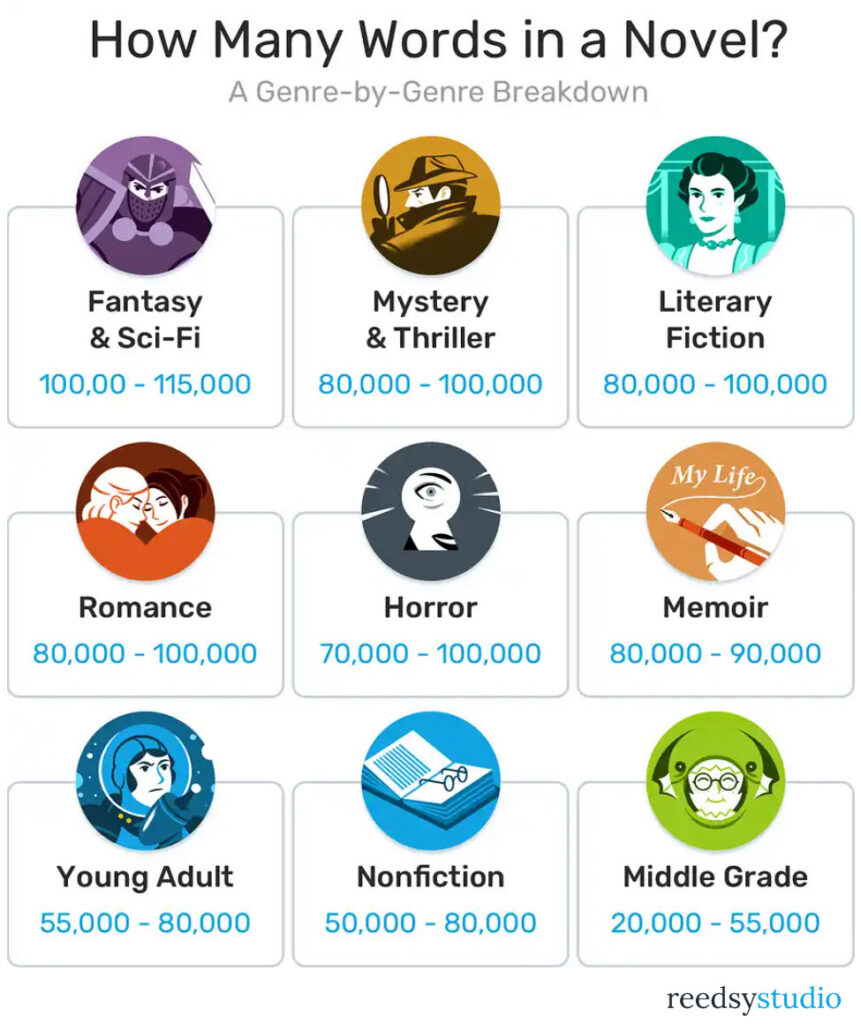
How to make your book longer

If you’re trying to meet a publisher’s required wordcount or the standard for your chosen genre, here are some ways to make your book longer.

For nonfiction books, consider adding:

  • Illustrations
  • Charts & diagrams
  • Case studies
  • Visual examples
  • Checklists
  • Callouts & quotes
  • Definitions or glossary
  • Exercises

For novels, consider:

  • Expanding key moments by going deeper (but not fluffing it up)
  • – Increasing character development
  • – Adding scenes & chapters to extend journey
  • – Adding backstory
  • – Adding supporting characters & subplots to strengthen your primary theme
  • – Adding supplemental content as front matter or back matter, such as maps and history

This issue came up on the The Author Guild’s forum recently, where an author was trying to figure out what to do with the 40,000-word fantasy novella they’d written. One of the suggestions was to pair the novella with another related novella, or with a selection of related novelettes and short stories.  

The impact of self-publishing and ebooks on book lengths

Traditional publishers don’t like to publish novellas because they take nearly as much editing and design work as a full-length novel. This is despite the fact that most consumers don’t mind shorter novels.

Any stigma there was around shorter books has also been lessened by ebooks. When consumers aren’t picking a book off a shelf, they’re far less aware of the length of the book.

Both of those factors means there’s a growing market for novellas and other shorter books, but that market is largely the domain of self-publishers. 


Related posts:

Building up to a book

Why are we trying to discourage aspiring novelists from publishing?


To receive future posts for free or to become a Patron and support my dystopian sci-fi novel and get special thank-you goodies upon its publication… 

Why are we trying to discourage aspiring novelists from publishing?

I’m a big fan of learning by doing, and an even bigger fan of iteration. Every time you do something, you have an opportunity to learn and do it better next time. I think this includes publishing, so I was disturbed by some recent advice I read that full-throatedly discouraged writers from even trying to query and publish their first manuscript.

The person went on to suggest that aspiring novelists also consider their second, third, and even fourth manuscripts as “practice.” The advice appeared particularly aimed at writers who are college-age and younger.

My takeaway was: Don’t rush into publishing. And don’t publish until you can get an agent. They’ll tell you when you’re ready.

While that advice has the musty smell of the top-down, old world oligarchy publishing hierarchy, I believe it comes from a place of wanting to protect young writers from potential failures that might stunt their future writing careers. While that’s an admirable sentiment, the traditional publishing industry’s track record of predicting success is, let’s say, mixed. But more than that, what’s wrong with risking failure? 

In the business world where I spend my days, failure is rightly recognized as being valuable experience—sometimes more valuable than success. Aspiring novelists of all ages should embrace that kind of mindset for six important reasons:

1. Manuscripts are different from books.

Finishing a manuscript is not the same as finishing a book. The latter requires you to …

  • Work with beta readers
  • Work with editors (i.e., developmental editor, copyeditor, proofreader)
  • Write front matter (i.e., table of contents, dedication), back matter (i.e., acknowledgments), and jacket copy (i.e., book description, author bio)
  • Get a cover made

Yes, all of that takes time and some of it costs money—and I appreciate that not everyone has the ability to invest significantly in their book. However, doing all of that (to whatever degree you’re able) gives you valuable experience and skills you’ll be glad you didn’t wait to start obtaining.

2. Publishing isn’t the finish line.

Today, authors are expected to build platforms and it’s hard to do that if you’re not talking about the books you’re working on and following through to publication. Publishing builds credibility.

Authors are also expected to do publicity. I can tell you from firsthand experience that it is a learned skill. I remember vividly my first conference presentation—I was terrified, but got through it and got better through practice. Since then, I’ve spoken in front of audiences as large as several thousand people, and spoken across the US, as well as in England, Denmark, and Australia. (Europeans are a tough crowd.)

And even after all of that, I can tell you I’m extremely nervous about the prospect of doing publicity for my upcoming sci-fi trilogy. It’s going to be a whole new set of questions that I’m not used to answering. I’ll be exercising some new muscles, and it will take some training before those muscles are strong. Why put off building these muscles?

3. Success is in the eye of the beholder.

The chances are very good that the number of books sold that you’d be happy with and the number that a publisher or agent would be happy with are quite different. For perspective, during the Department of Justice v. Penguin Random House antitrust trial in 2022, it was revealed that 90% of published books sell fewer than 2,000 copies. Half of published books sell fewer than 12 copies. And that doesn’t include self-published books, which would surely bring those numbers down.

I’m not sharing that to lower your expectations, but rather to say that if you were to sell more than 2,000 copies, you should be thrilled. You’d be in the top 10%! But your agent and publisher might be less thrilled. 

4. Nothing wrong with having a back list.

In the wake of his success with The Fault in our Stars, I had the pleasure of hearing John Green speak. He mentioned that his first book, Paper Towns, had sold less than 1,000 copies … that is, until the success of The Fault in our Stars. Today, by all measures, Paper Towns is a very successful novel. It just took Green breaking out with his second book to bring a larger audience to his first book.

Relatedly, some books fail to be picked up by agents or publishers because the genre is out of favor or the book doesn’t easily fall into a clear genre, not that the story isn’t good. Yes, you could stuff it in a drawer and wait for the right time to come along (which some authors do), or you can move forward and see what happens.

5. Book success goes beyond book sales.

It bears repeating: Publishing builds credibility. As I explained in a recent post, having a book out there opens doors, creates opportunities, and makes you more valuable.

6. You can protect yourself with pen names.

Fearful that your book may not be good enough and want to protect yourself? Use a pen name. Did you release a book under your name that tanked? Use a pen name for your next book. Plenty of authors use a pen name to disassociate themselves from a novel that didn’t do well. Rinse, repeat.

It took me a couple of decades to find my reason for writing and my voice, but I recognize that some people find their voices much more quickly. Why wait to get out there and share what you have to say?

Ultimately, if you’re proud of your novel and have the means, you should publish it. Hard stop. Learn from the experience and then do it again.

I love what Paula Saunders, the author of Starting From Here, told The Shit No One Tells You About Writing recently:

“You have to be willing to try. Which means you have to be willing to fail. Either way, you’re winning.”

I hope everyone takes that to heart.


To receive future posts or to become a Patron and support my dystopian sci-fi novel and get special thank-you goodies upon its publication, subscribe on Substack →

Why I self-published my nonfiction books

Honestly, I didn’t give much thought to trying to get my nonfiction books traditionally published. Here’s why I self-published:

  • I’d worked at two book publishers, Texas A&M University Press and Marlowe & Co., so I was familiar with the publishing process.
  • I knew platform size is the primary determinant of nonfiction book success and that I already had a solid platform.
  • As a former managing editor at a magazine, I was confident in my page layout skills.
  • I knew Amazon had 70% of the book market, so being present in that one store would give me exposure to the majority of book buyers. (That made publishing through KDP a no-brainer.)
  • I knew self-publishing would be much faster.
  • I also knew I’d have much more control and already had a clear vision for the book.

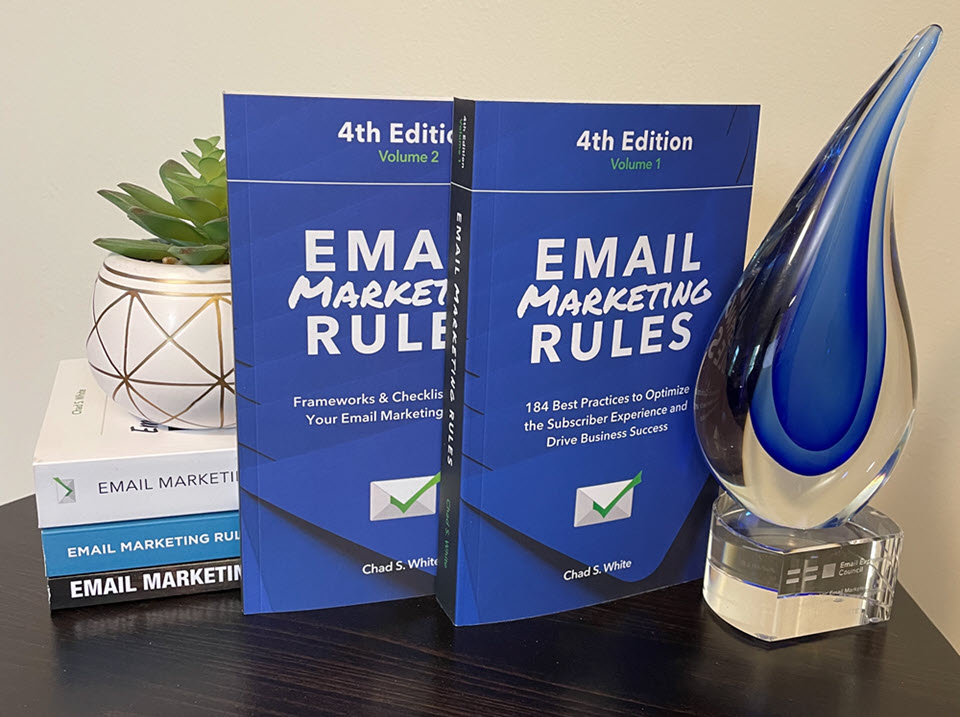
Thankfully, all of those things turned out to be true. In less than a year, I was able to write the 214-page first edition of Email Marketing Rules, have it edited by some of my trusted industry friends, get it professionally copyedited, and publish it.

But there were additional benefits of self-publishing I didn’t realize until later. For example, a traditional publisher would have never allowed me to publish a 322-page second edition 18 months after the first edition. And they definitely wouldn’t have allowed me to publish a 677-page two-volume fourth edition.

Did all of those decisions maximize profitability? I’m sure they didn’t. But I don’t regret any of them, because those decisions capitalized on my excitement and allowed me to create books I’ve always been proud to put my name on.  

Self-publishing gives you lots of control. Make sure you’re using it to maximize your vision.

All four editions of 'Email Marketing Rules' by Chad S. White
All four editions of Email Marketing Rules

To receive future posts or to become a Patron and support my dystopian sci-fi novel and get special thank-you goodies upon its publication, subscribe on Substack →