Good Writing: An Evening with Anne Lamott & Neal Allen

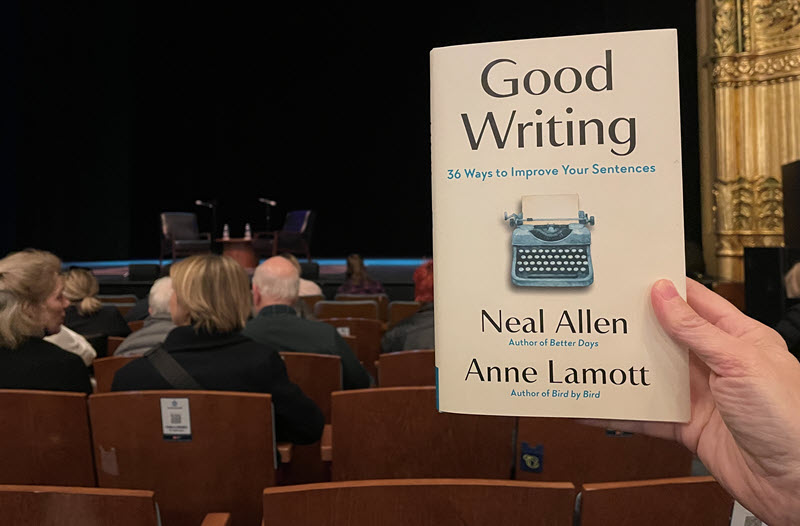
As a 20th wedding anniversary gift, my wife Kate got us tickets to see Anne Lamott and Neal Allen talk about Good Writing: 36 Ways to Improve Your Sentences, which they wrote together. Since Kate and I have published seven books between us, and have aspirations to write more and eventually co-author a novel, we were curious about them as a writing duo. I was also curious about their thoughts on the issues of the day, and since the audience could submit questions, I asked them and was fortunate enough to have them pick my questions.

Moments before Anne Lamott and Neal Allen took the stage to discuss Good Writing and answer audience questions

Social media & book reviews

In response to my question about how social media has changed in the publishing industry, Lamott said, “There are no more book reviews in the world. It’s all social media.”

She added that Good Writing was her 21st book and her first launched with no book reviews. “You have to create a platform.”

That’s sobering advice for every writer who hates social media and platform building.

The role of artificial intelligence

Along with many others, I asked about their views on artificial intelligence. Neither of them was interested in using it for writing, with Lamott joking, “I don’t know how to operate a toaster.” Allen said he wasn’t tempted to use AI for writing because the writing is the part he enjoys. Later, he would say, “It’s only through writing the book that I discover what I don’t know.”

That said, both Allen and Lamott were in awe of AI. It has not only read every novel, said Allen, but all literary criticism. “AI is going to be the authority.”

At times, Lamott sounded downright fatalistic about AI. A Sunday School teacher until recently, she said she asked ChatGPT to write a Palm Sunday talk “in the style of Anne Lamott” and confessed that it was “exquisite.” She concluded, “There’s no reason for me. It can write me.” That statement alarmed the audience.

“I think there will be guilds like there were in the Middle Ages,” added Lamott, who’s concerned about the impact AI will have on her son and grandson. “There will be people huddled together escaping AI.”

The purpose of writing

While that sounds dystopian, both Lamott and Allen see writing as a personal endeavor first, an interpersonal endeavor second, and a community endeavor last. Lamott said the fulfillment is in the writing, not the publishing. 

“The respect you’re looking for is only from within,” she said, “and that’s terrible news for people who just got an agent.”

In arguing that it’s about the writing, Lamott went so far as to say, “I’m not going to be remembered.” That also shocked the audience. But she backed it up by rattling off a list of great authors she loves who aren’t read anymore.

The option of self-publishing

However, it was difficult to square those views with others they expressed, particularly when I asked about self-publishing.  

“If I was younger, I’d really consider self-publishing,” said Lamott, acknowledging that getting an agent and a publisher is “so hard.”

They shared that Allen self-published a book he wrote that didn’t sel. It went on to sell 3,000 copies, which the audience applauded. Those sales figures put his book solidly among the top 10% of all published books, which is applaud-worthy indeed, even if they aren’t blockbuster sales numbers.

However, he said his agent is currently trying to sell a novel of his, and that he wouldn’t self-publish this one if it didn’t sell. In another surprising turn, he added, “I don’t think the world needs my novel.”

Given his statements about writing for the sake of self-discovery and self-fulfillment, perhaps that makes sense. But it begs the question: If publishing doesn’t matter and the world doesn’t need his novel, then why is he having his agent try to sell it?

For my part, I’m going to pretend he didn’t say that and focus on something else he said instead: “Everyone is yearning for intimacy with the world.”

That rings true to my ears. And that’s why I think self-publishing is such a game-changer. It gives everyone a chance to be heard and to affect others—however fleetingly. 


Related posts:

Building up to a book

Why are we trying to discourage aspiring novelists from publishing?

Where to draw the line with genAI


To receive future posts for free or to become a Patron and support my dystopian sci-fi novel and get special thank-you goodies upon its publication… 

Grammarly’s Expert Review debacle

I’ve never used Grammarly, in large part because it seemed largely a way to police wordcount progress (that’s extra stress I don’t need) and, more recently, was too close to AI (which I don’t want to be a part of my novel-writing process). The recent scandal around their Expert Review AI agent validates my feelings.

Grammarly launched Expert Review last August, with the AI agent “designed to help users discover influential perspectives and scholarship relevant to their work,” according to Shishir Mehrotra, the CEO of Superhuman, which operates Grammarly. However, in an announcement on LinkedIn this month, he said they have disabled the feature while they reimagine it “to make it more useful for users, while giving experts real control over how they want to be represented — or not represented at all.”

That last bit is a soft acknowledgment of what they’d done wrong with Expert Review. Ann Handley, the author of Everybody Writes, casts a bright light on their mistakes:

Read Ann Handley’s comment on LinkedIn

I couldn’t agree more with Ann Handley’s comment. Not to be overly dramatic, but things like Expert Review are exactly why so many creators, artists, and writers see AI as a threat—not just to their livelihoods and reputations, but to their passions. AI can be used responsibly. All technology providers—but especially those who want to be seen as allies to creatives—have to try harder.


Related posts:

Where to draw the line with genAI

The Age of De-Skilling: Who do you want to be?


To receive future posts for free or to become a Patron and support my dystopian sci-fi novel and get special thank-you goodies upon its publication… 

The Age of De-Skilling: Who do you want to be?

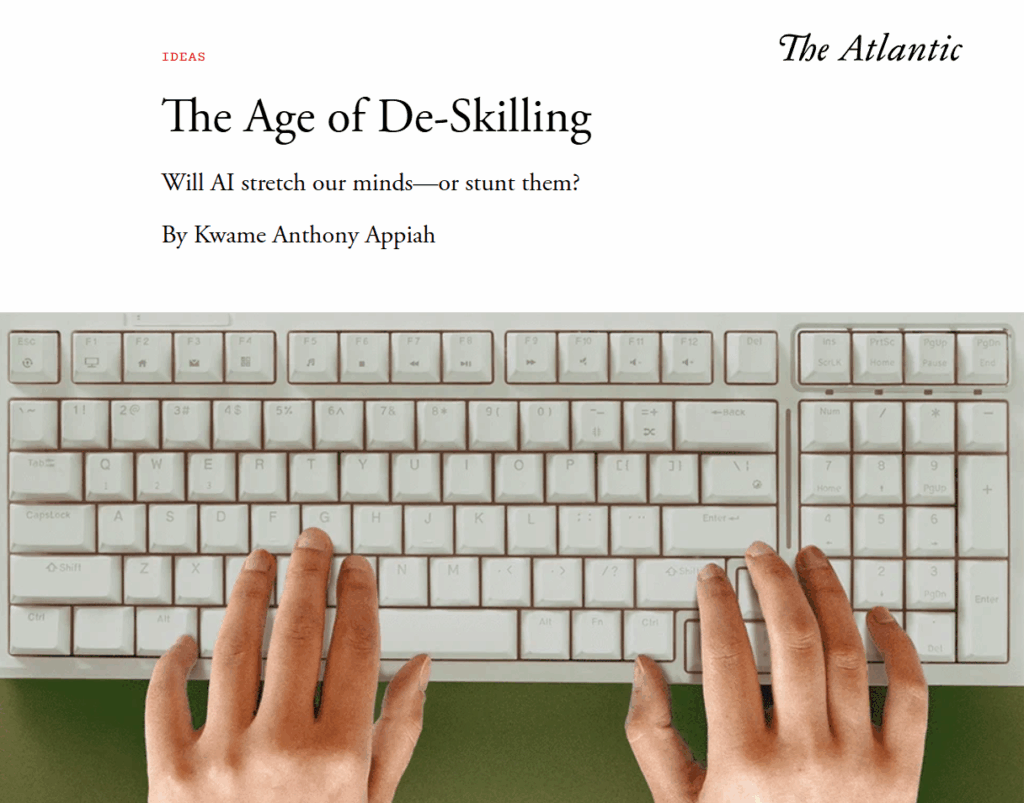
From the gramophone to compass to the computer, advancements in technology routinely cause people to abandon skills, says The Atlantic’s Kwame Anthony Appiah in The Age of De-Skilling (link to gift article). 

“It’s a reassuring pattern—something let go, something else acquired,” he says. “But some gains come with deeper costs. They unsettle not only what people can do but also who they feel themselves to be.”

Of course, AI is the next big advancement that’s causing the current cycle of de-skilling. The question is: What skills will people be giving up? And how will that impact their identity?

In these cycles, people have several paths available to them:

1. The cyborg

They can use the technology collaboratively, keeping their skills while gaining speed, precision, or other benefits from the technology.

2. The monitor

They watch over the technology as it does their former job, stepping in to assist when the technology falters. In this role, the person invariably loses skill and their former identity.

It’s around these two choices that most of the conversation about AI has revolved. Will you be the “human in the loop” that stays actively engaged in your craft? Or will you be the “human on the loop” that merely oversees and signs off on the work the technology does?

But I think there are two other options.

3. The innovator

Freed from some aspects of their profession or task, they specialize in one or more of the remaining aspects. In the age of AI, this means focusing on very niche subject areas where there’s relatively little domain knowledge—or, more commonly, being on the forefront of new discoveries. The innovator doesn’t compete with the new technology. Instead, they expand knowledge or pioneer new methods, which over time improve the new technology or fuel the next technology innovation. 

4. The artisan

Some people will continue doing things the old way. They will maintain their skills and identity, but compete directly with the new technology. In some cases, a critical mass of consumers will appreciate this human- or hand-crafted product or service, making it a viable choice. In other cases, there won’t be a viable market.

I recognize that not every person in every instance will have full discretion over which of these paths they take as AI spreads across industries. However, in my day job, I’m going to lean into being a cyborg and specialist, as that makes me the most valuable as a digital marketer. And in my night job as a novelist, I’m going to lean into being an artisan, as that best aligns with my values as a novelist.

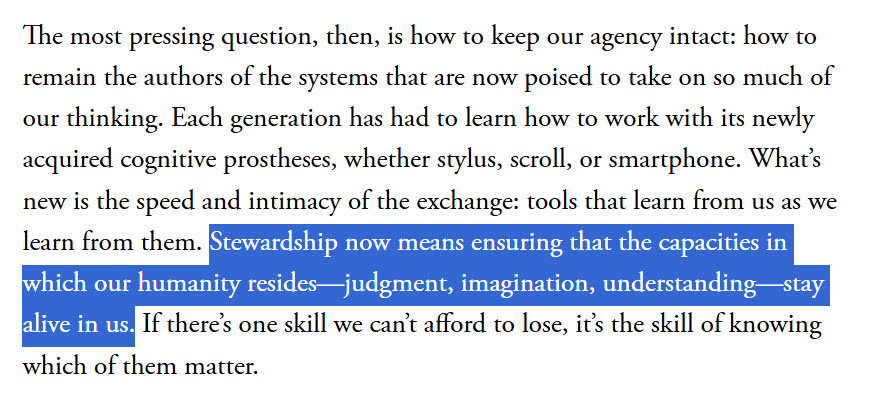
The final paragraph of The Age of De-Skilling by Kwame Anthony Appiah in The Atlantic

Related posts:

Where to draw the line with genAI

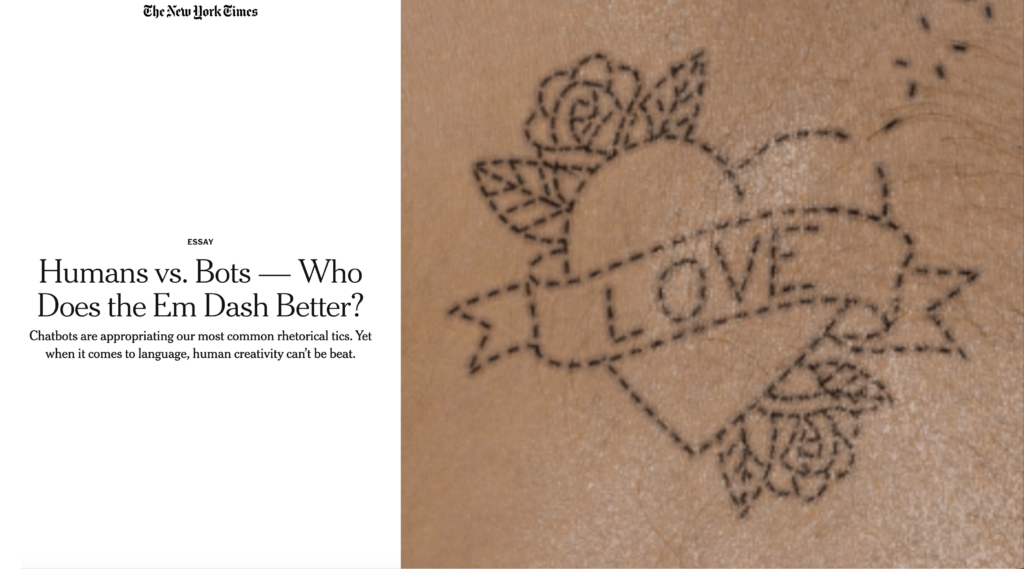
Confession: I love em-dashes


To receive future posts for free or to become a Patron and support my dystopian sci-fi novel and get special thank-you goodies upon its publication…

Confession: I love em-dashes

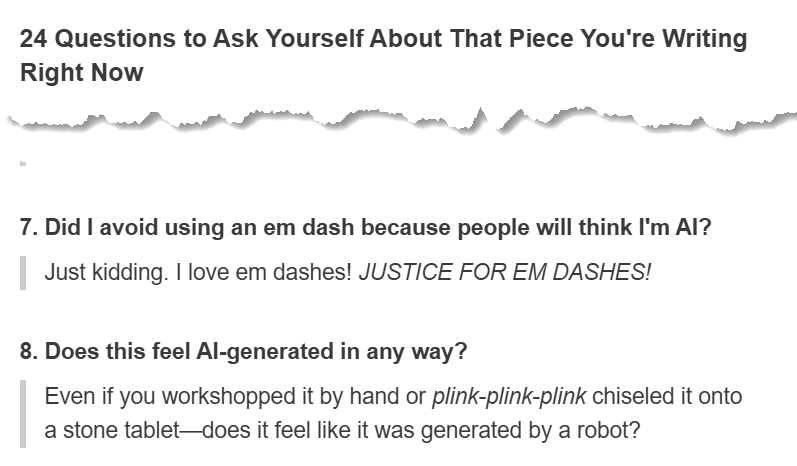
Because generative AI engines like ChatGPT use them a lot, some writers are starting to reconsider their use of em-dashes (which are so named because they’re the width of a capital M). I get it. No one wants to be accused of using genAI when they didn’t. 

But the fact that genAI produces copy with a healthy number of em-dashes only means that em-dashes are well-represented in their training material, and are therefore a staple of good writing. Cutting the versatile em-dash from your writing will only leave it worse off.

For what it’s worth, I use them all the time in my business writing. Heck, there are five in my latest article for CMSWire. And in the draft of book 1 of my sci-fi trilogy, I have more than 600 em-dashes. That comes out to one about every 150 words on average.

That may sound like a lot, but I use them …

  1. When a character’s speech is interrupted—by another character, a door slamming, or an explosion
  2. When a character stutters when they’re flustered (e.g., “I— I think”)
  3. For labored speech, like when they’re out of breath
  4. When a character’s thoughts are labored and fractured, like before they pass out
  5. To offset a clause more emphatically than a comma can
  6. For asides in speech, instead of using parentheses
  7. Before a list, instead of using colon

Beyond that, they’re just a fantastic tool for controlling the rhythm of a sentence. So, no matter what genAI spits out, I’m going to keep using em-dashes. And for the record, I’m going to keep using periods and commas, too, even though those are also suspiciously common in genAI copy.

From Issue 192 of Total Annarchy, a wonderful newsletter by Ann Handley

Related posts:

The Age of De-Skilling: Who do you want to be?

Where to draw the line with genAI


To receive future posts or to become a Patron and support my dystopian sci-fi novel and get special thank-you goodies upon its publication…

Where to draw the line with genAI

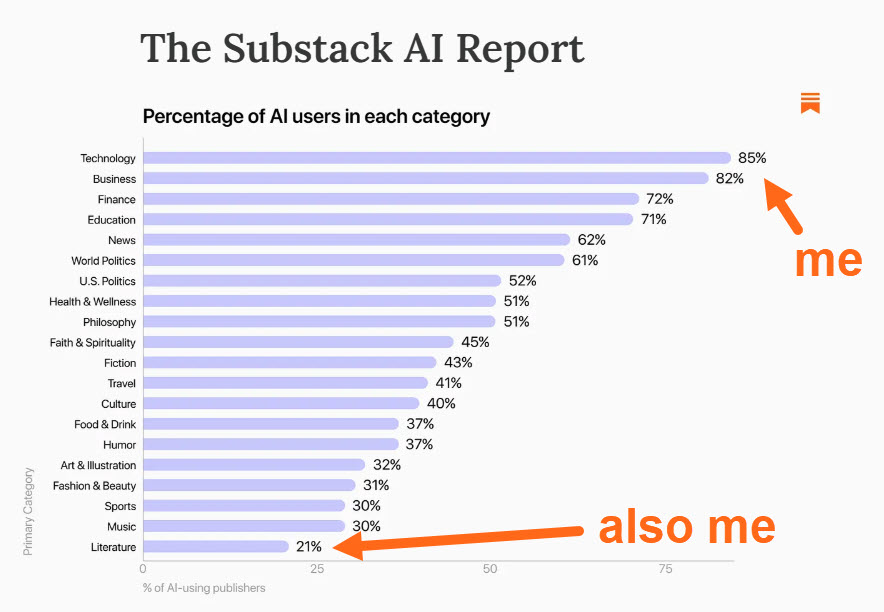
I’m a member of the group that’s most bullish on generative AI and the group that’s the least. That’s because I’m a marketing strategist at a tech company by day and an aspiring novelist by night. The latest survey from Substack illustrates the extreme divide between these two groups.

Wearing both of these hats, here are major issues I see:

  1. Anything created substantially using genAI can’t be copyrighted. (And if governments are smart, that will never change.) This is why agents and publishers want to know if you’ve used AI in your book, because it could potentially zero out the commercial value of your book. AI-generated images for covers are similarly problematic.
  2. Using genAI opens you up to plagiarism lawsuits until the law gets settled here, which could take years. This is why some of our Fortune 1000 clients write into our agency service contacts that we can’t use genAI for any of the work we do for them. They don’t want the legal risk since they’re big legal targets already. The Big Five publishers surely feel the same way.

Of course, many writers feel genAI is morally wrong because it’s essentially a plagiarism engine. And their minds won’t change even if the courts rule that genAI’s use of copyrighted material is transformative (which is highly likely to happen).

But putting those feelings aside for a moment, let’s recognize that some genAI uses don’t run afoul of those two issues above because they’re noncommercial. For example, turning your human-authored book summary into social media posts to promote your book. Or creating AI-images of your protagonists based on the descriptions in your book to use on social. Or taking the short author bio you wrote for your jacket copy, adding a bunch of details, and having genAI draft a long bio for your website.

Let’s also acknowledge that genAI is a huge boon for people with dyslexia and ADHD, as well as non-native English speakers.

All of that said, I’ve made the personal decision not to use genAI in any way for the writing of my novels, including AI-infused editing tools like Grammarly. At the end of this very long road, for better or worse, I want to be able to take full credit (along with my editors and beta readers) for everything in my novels, including the human imperfections.


Related posts:

Grammarly’s Expert Review debacle

The Age of De-Skilling: Who do you want to be?

Confession: I love em-dashes


To receive future posts or to become a Patron and support my dystopian sci-fi novel and get special thank-you goodies upon its publication