After an initial unsuccessful round of querying, I worked with a developmental editor and made huge improvements over the past 18 months. It’s time for a final round of querying.
Book 2
📕 Draft complete!
✍️ 100,000 words, 27 chapters
▶️ Revise by April. ✍️
That’s when I’m handing the book 2 manuscript off to my developmental editor. But I need to apply what I learned from working with them on book 1 to the book 2 manuscript.
Book 3
📘 Work in progress…
✍️ 45,000 words, 15 chapters
▶️ Goal to finish draft by end of 2027 ✍️
With all my focus on editing book 1, this has been on the backburner. But I’ve been thinking a lot about themes and pulling all the threads together for the big ending.
In addition to having an editor look at my query letter, I had them review my synopsis as well. Unlike the teaser description that’s in a query letter, a synopsis includes spoilers. Basically, it’s your opportunity to demonstrate that your story has a coherent plot with ups and downs, some surprises, and a satisfying ending.
I’ll confess, trying to summarize a 95,000-word novel in around 600 words was a challenge, so I was grateful to get feedback on it. Here are the high points of my editor’s feedback:
1. Start with establishing the world
I didn’t do this well in my teaser description, and I didn’t do it well in my synopsis either, but it’s a must for sci-fi. Thankfully, it was an easy fix. It only cost me 45 words at the top of the synopsis.
2. Answer the big story questions only
A synopsis isn’t just a series of events. You have to explain their relevance and their impact on the characters. But you can’t explain everything, so you have to leave some things out.
That calculus is tough. My editor hadn’t read my novel, but they wanted more details about some points, and thankfully they were happy to have a few details I’d included cut.
3. Only name major characters
My novel has an ensemble cast, so the vast majority of characters aren’t mentioned in the synopsis. But I had included five named characters.
In response, my editor suggested, “If a character only shows up once or twice in the synopsis, and it’s not absolutely vital we know who they are, it may be worth removing or just summarizing.”
They singled out one of the five characters, which is definitely not a major character—neither in book 1 nor the trilogy—unlike the other four characters. So, they got anonymized to “friend.”
4. Give major characters their space
My novel has three major characters that get nearly all of the POV time. However, my original synopsis gave one of the three a lot less attention word-wise than the others, which made their role unclear to my editor. When I revised my synopsis, I rebalanced the attention paid to each (132, 148, and 149 words) and wove their storylines together more evenly to more accurately represent their importance to the story.
5. Spell out the stakes and consequences of failure
The stakes in my story are big, but I didn’t 100% spell them out—mostly because I was economizing on words and thought I’d inferred enough. But when the stakes aren’t clear, the story’s not clear. So, I cut other material to clarify the stakes for everyone.
In conclusion: Writing a synopsis is tough. It’s full of difficult choices as you try to highlight the most important and compelling plot points and moments, while omitting the rest so as not to confuse or distract. It’s a delicate balancing act.
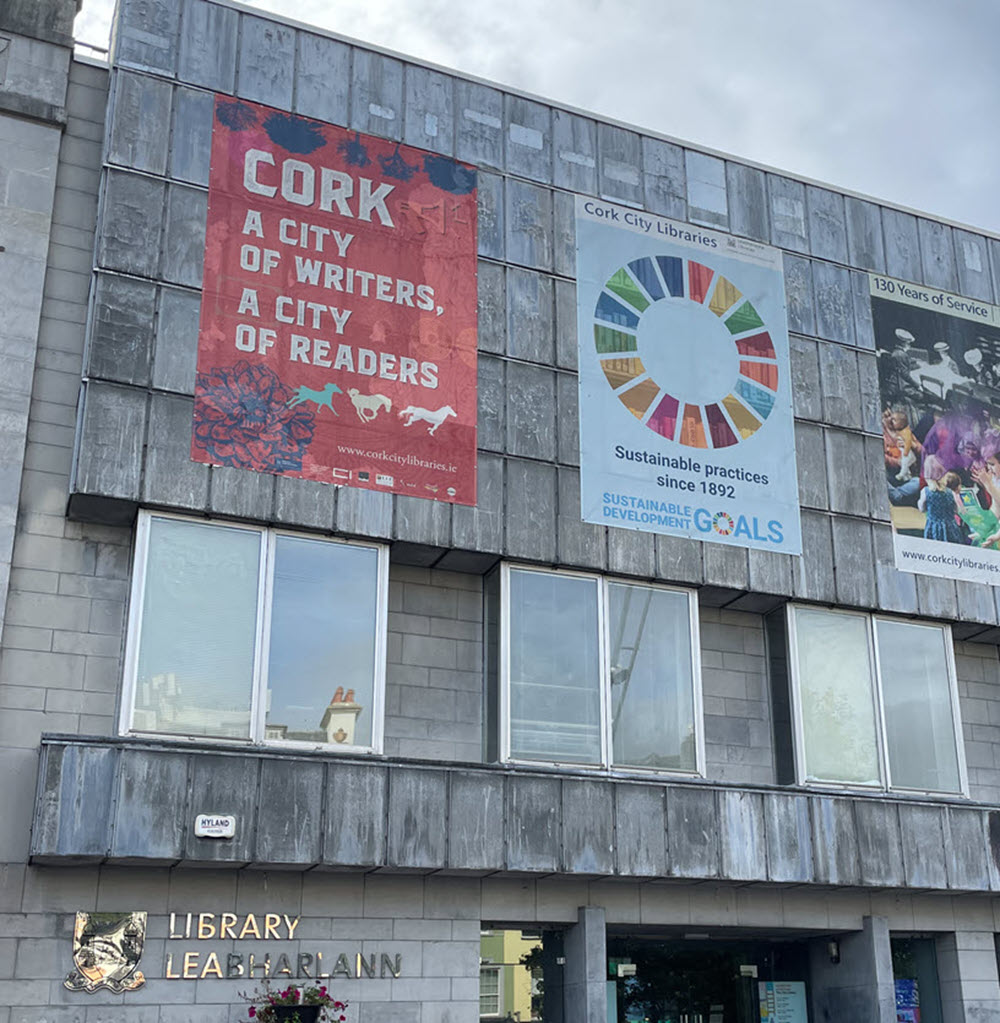
While I was visiting Ireland for the first time last month, I saw this sign on the Cork City Library, which is on the edge of the downtown shopping district:
Cork: A city of writers, a city of readers.
The city library in Cork, Ireland
As a marketer, my first thought was that this was some wonderful aspirational marketing. Of course the library wants the city’s residents to think of themselves like this.
But then I realized that I’d passed three bookstores downtown. I’ve been all over the US and I can’t think of a time when I passed three bookstores on the same street all within a mile of each other.
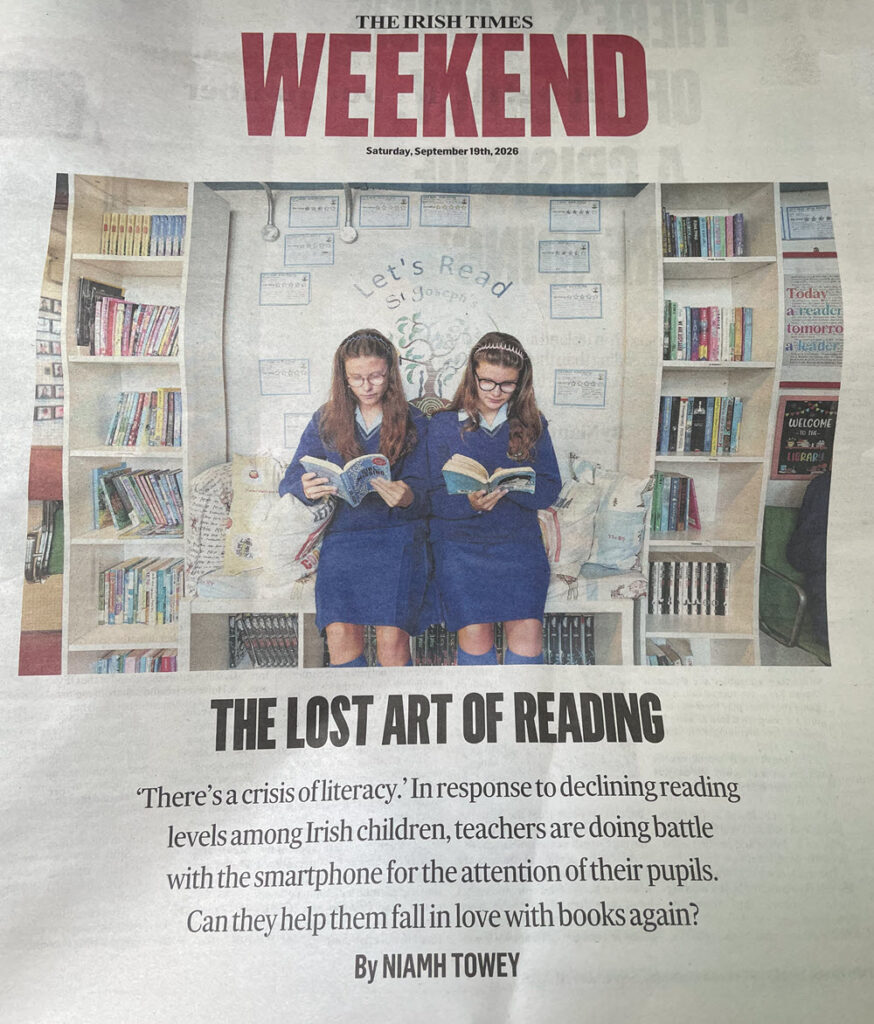
Then I saw a frontpage story in The Irish Times Weekend edition about how teachers are battling a “crisis of literacy.” Yes, despite Ireland being No. 1 in Europe in the international reading league tables and 7th globally, they’re battling the same rapid decline in reading that we’ve seen here in the US among young people.
As here, Ireland sees a huge correlation between the decrease in reading and the increase in smartphone ownership. They also see a massive positive correlation between parents reading for fun and their children reading for fun. Sadly, only 2% of American parents read to their children.
It feels like a little chicken and the egg scenario. But I think the battle for books and literacy is most likely to be won among kids, rather than trying to turn things around with adults. If we can instill an appreciation and enjoyment of books in kids before they leave high school, then they’re likely to hold onto that and pass that love of books on to their children.
What do you think?
The frontpage article on The Irish Times Weekend edition about the “crisis of literacy” among Irish children
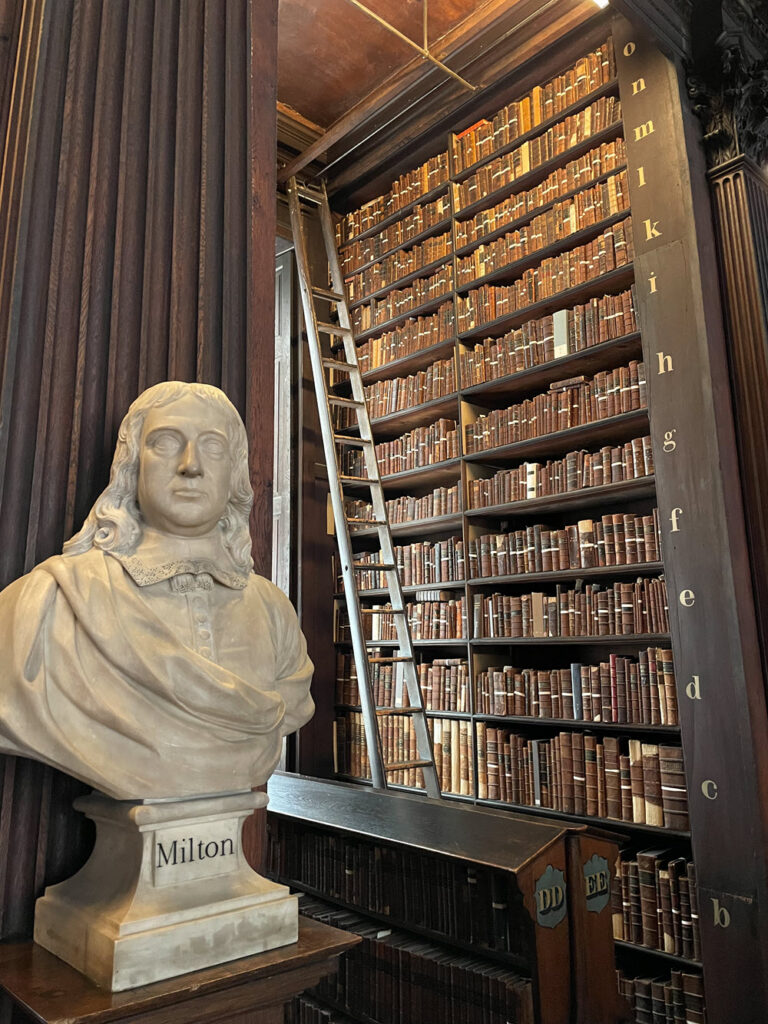
I just returned from my first-ever trip to Ireland, where I learned all about the island’s long history, from Viking settlements and British colonization through the Great Famine and independence. One of the highlights of my week there was a visit to The Long Room in the Old Library at Trinity College Dublin.
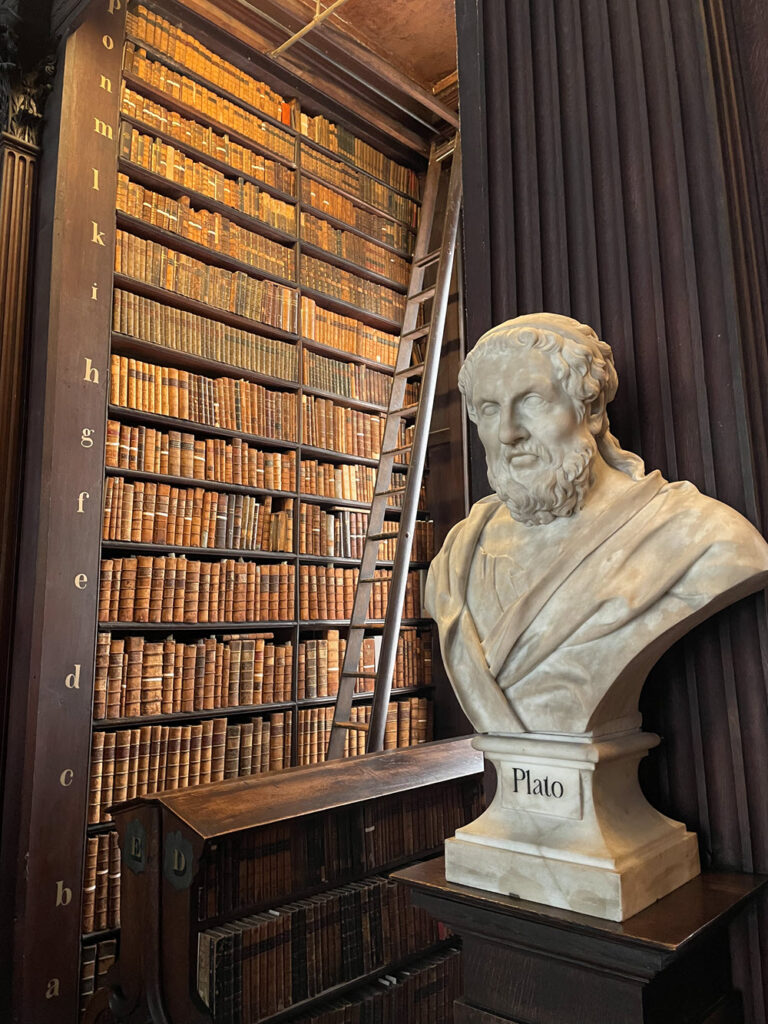
Walking in the huge hall gives you serious Beauty & The Beast library vibes, with its book bays and ladders and vaulted ceiling and magical floating globe. Functioning like the US’s Library of Congress, the library houses every printed work published in the British Isles. To better accomplish that, the library is about to undergo a multiyear renovation. My wife and I were among the last visitors to see it before it closes to the public. Even with most of its shelves already emptied in preparation, it’s stunning.
The Long Room at the Old Library at Trinity College Dublin
Well, I now have their feedback and wanted to share how I did, in case it helps someone else. I’ll share the feedback based on the four goals of a query letter.
1. Establish your novel’s genre
I referred to my book as a “dystopian near-future sci-fi novel.” My editor gently pointed out the redundancy inherent in that description. Dystopian is a kind of sci-fi, so strike “sci-fi.” And the query letter itself establishes that I’m pitching a novel, so strike “novel.” They also thought “near-future” was unnecessary, which I agreed with since my description talks about the year 2104, which establishes it as near-future.
So, in the end, “dystopian near-future sci-fi novel” was shortened to just “dystopian.”
2. Present a few comparable books
This is one of the elements I really failed on during my first querying attempt. The two comps I stressed the most were from 2010 and 2013. The expectation is for comps to be within the past 5 years, and ideally within the past 2. My new comps? Published in 2020, 2023, and 2025. My editor didn’t have any feedback on those.
However, I also namechecked the Pacific Rim and Hunger Games franchises, as a way of further defining the audience for my novel. I mentioned those in the opening paragraph as well, but my editor moved them after the description. So, those older titles are still in there, but deemphasized. Seems wise.
3. Share a teaser description of your novel
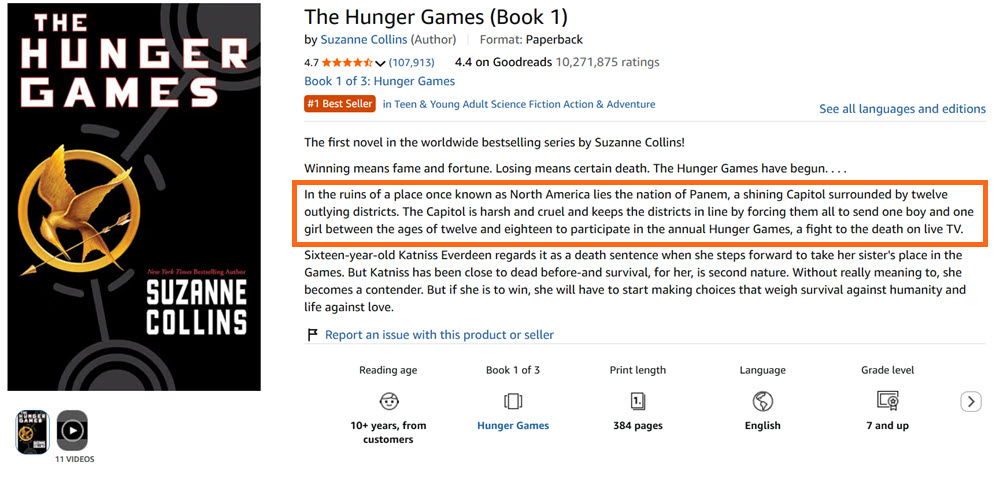
Unlike a synopsis, which includes spoilers, the description is similar to what the jacket copy would be. In my teaser book description, I jumped right into the two main characters and their circumstances and goals. While that’s fine for most genres, my editor recommended doing some upfront worldbuilding for my sci-fi novel, similar to what the jacket copy for The Hunger Games does.
Like in the description of The Hunger Games, I needed to establish the world before introducing the main characters
It made perfect sense once it was suggested. In fact, each of the books in my trilogy begin with a one-page Star Wars-esque, Greek chorus-like intro that firmly establishes the context of the world and recent action. Of course I needed to bring that element into my summary teaser.
In addition to that, I was too coy about the antagonists of my story, referring to them as “mysterious forces.” Upon revision, I name them: “a trio of artificial intelligences and the resistance group Stateless.”
4. Introduce you as the author
I thought my revised bio paragraph was much better than my original—particularly in establishing why I wrote the story—and my editor agreed: “This is fantastic! A compelling reason for writing the book, great prior experience, and mention of platform.”
All in all, not huge changes, but substantial ones for sure. It’s definitely stronger now. We’ll see if it’s strong enough when I resume querying next month. Wish me luck!
Before handing off my updated query letter to my editor, I made significant revisions based on the errors I’d learned I’d made after querying my first 30 agents in 2024. Here are the five biggest mistakes I now know I made:
Unfortunately, the comps I stressed the most were from 2010 and 2013. [sad trombone]
Halfway through querying I started to include a longer list of comps with some more recent titles. However, only two were from the last 5 years, and none were from the last 2 years.
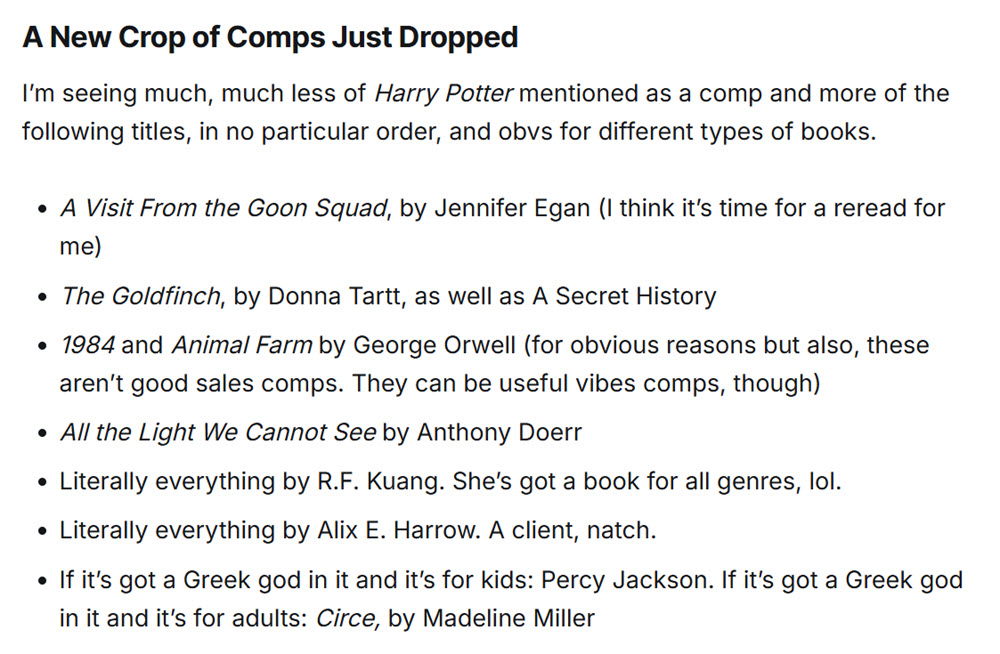
I felt less bad about my poor comp choices after reading Kate McKean’s Dispatches from the Slush Pile article, which highlights some of the most common bad comps used today. But I’m glad I was able to identify much more recent comps, which I’m almost done reading.
Out-of-date comps that Kate McKean is seeing frequently
2. My summary didn’t include my protagonists’ motivations.
I included their goals, but not why they were pursuing them. Including the Why makes them much more relatable.
3. I waited to start building my fiction author platform.
Like a lot of first-time novelists apparently, I thought it would be easier to establish my author platform once I (hopefully) had an agent, which I’m sure is true. I also assumed agents would see that I built a solid nonfiction author platform and could therefore do it again.
For those reasons, I waited until after my initial batch of queries were out to launch ChadSWhite.com and my presence on Instagram and Substack. I regret waiting. I’d forgotten how long it takes to build up a positive reputation with Google and the social media algorithm gods.
4. My story question wasn’t strong enough.
My story teaser ended with a question, but it wasn’t strong. Now it expresses a clear goal for my heroes and clear stakes should they fail.
5. I didn’t say why I was the person to write this story.
Despite being over 100 words long, my initial bio didn’t explain why I wrote this story. My revised bio answers that in the first sentence: “This novel was inspired by the loss of my daughter, who I’ve reimagined as Octavia.” That’s what has allowed me to keep my writing momentum going. I made that change and then pared my bio down to 82 words.
Although technically not part of the query letter, I also didn’t format my manuscript to industry standards. We’ll call that an unofficial sixth thing that could have been better.
And now I’m waiting for my query letter editor to presumably add a few more items to my list of needed improvements. I’ll share those soon.
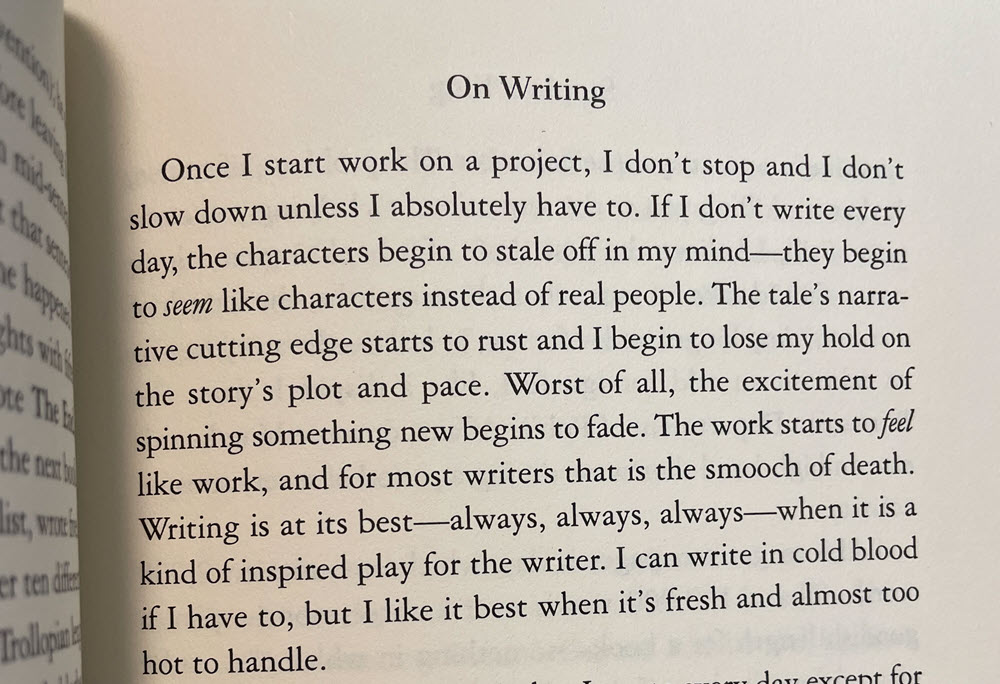
In On Writing, Stephen King says that when he starts a new novel, he writes and edits everyday to prevent the story from losing focus in his mind. I remember reading that and being incredibly discouraged, because I knew I couldn’t do that.
I’ve heard lots of writers talk about getting that first messy draft done quickly. Essentially, it’s an acknowledgment that editing is generally much easier than writing, so just get stuff down and then you can go back and start editing.
Even though I know that’s true from all my years as a journalist and business writer, I haven’t been able to completely embrace that in my fiction. Because the story threads are so long and there are so many narrative dominos, getting stuff down too hastily can mean re-sewing huge sections and reordering, removing, and adding lots of new dominos. For me, especially since I’m working on a trilogy, I’ve found that a more deliberative writing process works better. That means doing …
Other things besides actually writing
Some of my most productive weeks didn’t involve much manuscript writing. Instead, they involved:
Worldbuilding. Especially critical for sci-fi and fantasy authors, I’ve found that this process is very much ongoing throughout the first draft and beyond, rather than being something you completely nail down ahead of time. Invariably, this is intertwined with other non-writing activities.
Research. As I’m fleshing out my ideas and outline, or trying to decide which fork in the road to go down, I’m invariably doing research on all manner of people, places, and things.
Picking the right names. Sometimes the names of my characters come easily, and other times I really have to work for them, especially the minor characters. But names are so critical to being able to visualize a character fully, and therefore critical to being able to write them fully. I’ve spent a fair amount of time researching names, but that’s a subject for another day.
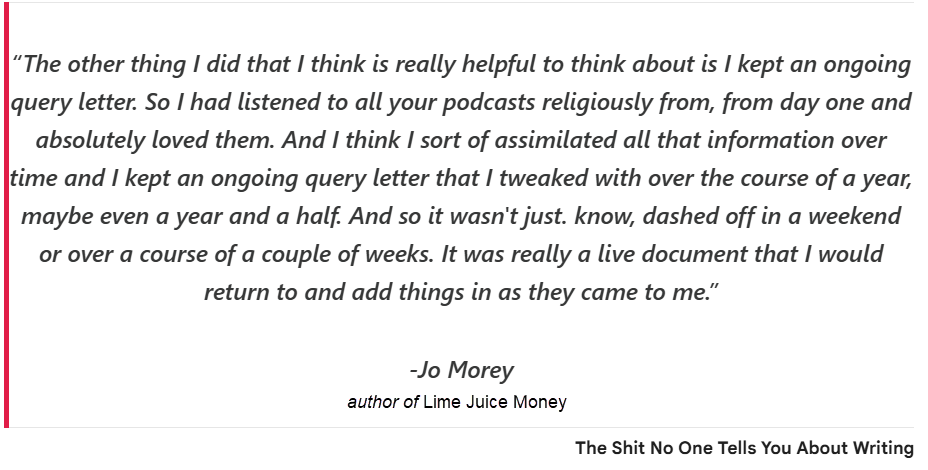
Publication planning. This may seem like a silly thing to plan while writing a novel, but working on your novel description, comps, marketing plans, and other elements as you go is easier than doing it all at the end, as Lime Juice Money author Jo Morey told The Shit No One Tells You About Writing. It can also bring clarity to your editing process.
Platform-building. In addition to writing blog and social posts, and catching up on the people I follow, I have a running list of more than 200 ideas for future posts. Among the most important are the ones that document my inspirations, which now seem vital in proving your writing is AI-free.
Editing. While most folks advise you to write and then edit, I find myself doing quite a bit of editing as I go. It really helps me get back into the story and regain the flow after I’ve stepped away.
Reading about craft. Whether articles, blog posts, or books about novel-writing, publishing, or book marketing, reading the advice of others has helped me become a much better writer—whether I accept the advice or not. And even when I encounter advice I’ve heard before, it serves as a good reminder or makes me think about a principle in some new way.
That’s a lot of non-writing activities. But even so, many days I don’t do any of those things either. Ultimately, I’m doing the best I can, and not beating myself up for not living up to some mythical ideal.
After unsuccessfully querying my dystopian sci-fi novel (Project: T.A.G.) a couple of years ago, I decided to work with a developmental editor, which was a fantastic decision. With substantial revisions nearly done, I’ve revisited my query letter and synopsis, making updates to those, too.
Honestly, I read more stuff after my initial failed querying attempt than before, so I now know I had significant flaws the first time around. But hopefully I’ve fixed those problems.
To be sure, at the urging of my wife Kate, I’ve hired an editor, Sean, to review both my query letter and synopsis. Kate worked with a book proposal editor for her first solo nonfiction book and was able to fairly quickly get an agent and attract offers from two publishers. Fingers crossed that a well-edited query letter and synopsis will bring me similar success.
Fellow authors…
Have you worked with an editor on your query letter, synopsis, or book proposal? If so, do you have any learnings to share? What were your blind spots?
Writers have conflicting advice when it comes to the use of the speech tag “said.” A number of folks, particularly on Instagram lately, have argued that writers should vary up their speech tags, in much the same way you’d vary your adjectives, verbs, and nouns.
The argument against “said” goes: Why use “said” over and over when you could be mixing things up and using “declared,” “replied,” “announced,” or other verbs?
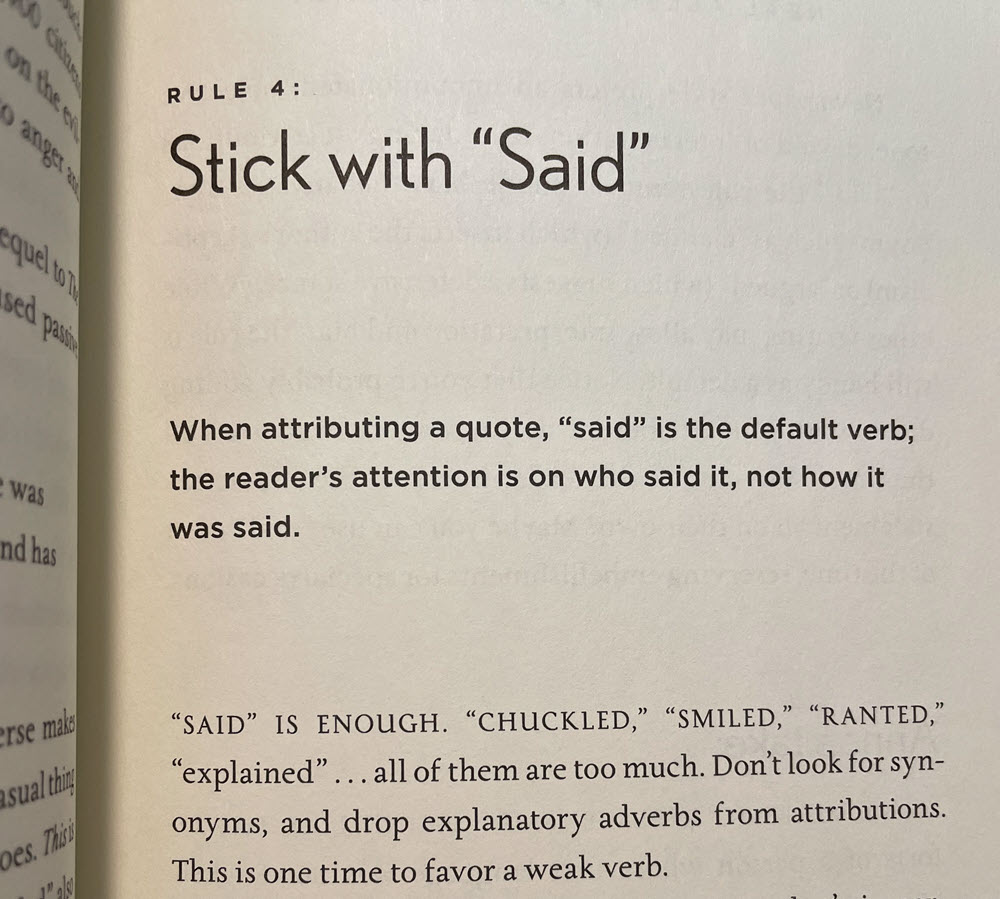
That said, most of the books on novel writing I’ve read have been pro-“said.” The one that immediately comes to mind is Good Writing by Neal Allen and Anne Lamott. It shares 36 ways to improve sentences and rule #4 is “Stick with ‘Said.’” While not technically a ranked list, the earliest rules do seem more fundamental, so it being #4 is saying something.
From Good Writing by Neal Allen and Anne Lamott
Others have argued that “said” is so common and so expected that it’s functionally invisible—like an article or conjunction. In The Fantasy Fiction Formula, Deborah Chester goes a step further and likens “said” to punctuation.
A journalistic influence
Like myself, Allen is a former journalist, so this rule makes a lot of sense to me. “Said” is neutral and unbiased, which is important in journalism. Embellish the speech tags on quotes and you’re editorializing.
That said, novels aren’t journalism. And as with most of Neal’s rules, Lamott delivers some counterpoints, arguing in favor of some “said” alternatives like “mumbled” and “whispered,” for example. I agree with Lamott that speech tags like those that tell how a statement was physically delivered are useful.
A crutch akin to an adverb
But here’s the part in Neal’s argument that really resonates with me. He says, “Why not let the reader interpret the character’s statement all on their own?”
That feels like the general rule about choosing strong verbs so you don’t have to use adverbs. For instance, if you have to say, “he quipped,” then perhaps it’s not a good quip. Similarly, if you’re dialogue is solid, there’s no reason to use the speech tags “agreed,” “promised,” or “conceded,” for example, as they’d just be redundant with the dialogue.
To bring in the adverb angle, that’s in the same vein as “he said snidely.” The character’s words, body language, and context should convey his snideness without you having to say so.
Keeping myself honest
So, where do I come down on this issue in practice? I did a quick search for speech tags in the manuscript for the first book in my dystopian sci-fi trilogy (Project: T.A.G.), which has been seen by a developmental editor and copy editor. Here’s a partial breakdown:
You can see I’m solidly in the present tense of the “said” camp, but not an absolutist. “Asks” feels similarly invisible to me. “Whispers,” “announces,” “mumbles,” and “declares” bring a little color to the physical manner in which things were said. The “barks” are mainly associated with one character, and the “coos” with another, so those are part of characterization.
The next best thing to ‘said’
I also did a quick check of the very first draft of my manuscript and found that my latest version has 10% fewer speech tags overall. In most cases, I was able to replace speech tags with action beats that established which character is currently acting, rendering the speech tag unnecessary. While “said” is quite invisible, being able to eliminate a speech tag altogether is even better.
What do you think?
Do you prefer “said” or do you like to aggressively vary your speech tags or do you fall something in between?
If you’re like me and had to read The Elements of Style by Strunk and White in school, then you need to read this book. That’s because The Sense of Style by Steven Pinker will undo all the bad advice in The Elements of Style that you knew in your heart was wrong.
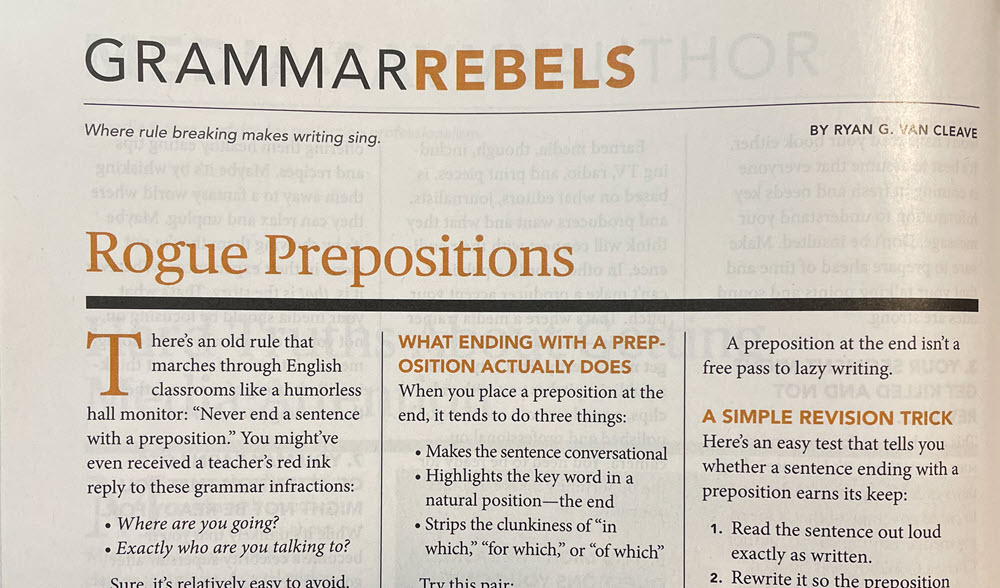
Never start a sentence with “and” or “but.” Never end a sentence with a preposition. That advice never made sense because people don’t talk like that, and don’t write like that either.
Essentially, Strunk and White tried to paternalistically force new stylistic rules on people because that’s what they thought was right. Pinker tells you how the English language works today—and in many cases, how it’s worked for a hundred or more years—and backs it all up with research.
I give it 5 stars, 6 dog-ears, and 1 Post-it.
Things I dog-eared and Post-it’d in The Sense of Style include:
A list of all the parts of speech
A list of “morbidly obese phrases,” such as “in the event that,” which can be simplified down to just “if”
A discussion of structural parallelism, which is a great rhetorical device
The principle of saving the heaviest for last
The cognitive philosophy of introducing a topic before your comment
A list of words and what they mean according to purists and what they mean according to common usage
The July/August 2026 issue of Writer’s Digest had a whole article on why it’s fine to end a sentence with a preposition