Confession: I gained 15 lb writing my first two books

Writing books is a long-term commitment to a solitary and sedentary activity. If you have a sedentary day job like me, then it can be a double-whammy for your health, as well as your social life.

Weight gain

After collecting notes for more than a year, I wrote my first book in an intense 3-month stretch. The 214-page first edition of Email Marketing Rules consumed nearly every night and every weekend. I gained 5 lbs. during the writing of it.

The second 322-page second edition of Email Marketing Rules took more than 6 months of nights and weekends to write. I gained 10 lbs. this time around.

It wasn’t just that I was sitting for 12+ hours a day. It was also that it was a series of sprints—pushing to get a draft out to beta readers, pushing to get a round of edits done, pushing to get the jacket copy finished, and on and on. For me, hitting those deadlines meant lots of caffeine and sugar to fuel late nights.

Neglect of family commitments

At the same time, I also bowed out of various family outings and pushed more household responsibilities onto my wife Kate. She was understanding with the first book, but not so much with the second.

Kate is super-understanding and supportive, but it’s fair to say that, after 6 months of shouldering an outsized percentage of parenting and household duties, she was pissed. She also knew this wasn’t my last book.

I vowed to do better. I promised not to opt-out of family activities and to wrap up evening writing sessions by 9-ish. For the three subsequent nonfiction books I’ve published and two fiction books I’ve written, I’ve kept my word. 

That has required longer time-horizons for books, but I think more planning and development has been better for the quality of my books as well. And it has certainly been better for my health, as I was able to drop all the weight I’d gained.

Resolve to write healthier

Some activities like writing can be hard on your body. Both real and self-imposed deadlines can make them even harder. As you set your goals for the year ahead, make sure you’re not unintentionally sacrificing your health or family responsibilities.


Related posts:

Confession: I love em-dashes

Confession: I love physical books


To receive future posts for free or to become a Patron and support my dystopian sci-fi novel and get special thank-you goodies upon its publication… 

Using unconventional formats, in small amounts

Unconventional formats are story structures that eschew the typical narrative flow of traditional formats, such as the three-act play, the Hero’s Journey, or Save the Cat. They are often less concerned with chronological time flow. And they can allow for modes of communications that are much more casual or much more formal, which can be more revealing or less revealing, depending on the device used. 

Unconventional formats include vehicles such as:

  • Letters, postcards, emails, and DMs (epistolary novels)
  • Diary entries
  • Obituaries
  • Blog posts
  • Social media posts and forum threads
  • AI prompts and outputs
  • Outlines
  • Transcripts and scripts
  • Legal forms
  • Police reports, disciplinary reports, case reports, and progress reports
  • Recipes
  • Instruction manuals
  • Lists

How I use these in my sci-fi trilogy

While entire stories can be written in these unconventional formats, I’ve enjoyed weaving them into my sci-fi trilogy (Project T.A.G.) to change up the storytelling mode. For instance, in book 1, a messenger delivers a letter that a character reads, reacting to every few sentences. Later, the MMC writes a letter home, commenting to himself as he goes about all the details he’s not including.

In book 2, the MFC struggles to write a letter to her father, saying too much and then editing it down to its simplest, irrefutable core. That rewriting process shows readers details and feelings that would have otherwise stayed hidden had only the final letter been included.

In book 3, one of the antagonists edits video content, including using strikethroughs to indicate word changes in the script. And later, to show the passage of time, one of the government leaders reads monthly tournament ranking reports—which is what I’m working on right now.


To receive future posts for free or to become a Patron and support my dystopian sci-fi novel and get special thank-you goodies upon its publication… 

Book review: ‘The Fantasy Fiction Formula’ by Deborah Chester

I read The Fantasy Fiction Formula on the recommendation of my developmental editor and found it to be highly helpful. It covers all the fundamentals of novel writing, from formulating a story plan to crafting a story climax, but also gives you a lot of tools to understand those elements better.

For instance, it includes a lot of charts and lists, including ones for different types of opening hooks and different story roles. One of my favorite frameworks is SPOOC, which shows you how the Situation, Protagonist, Objective, Opponent, and Climax all work together. Having a clear SPOOC gives you a massive headstart on writing your query letter and jacket copy. The book also includes plenty of drill exercises.

I give it 5 stars, 20 dog ears, and 5 Post-its.

For my dystopian sci-fi trilogy, two concepts from The Fantasy Fiction Formula were particularly helpful. 

The moral dilemma

Chester says that “a well-written third act requires the protagonist to be cornered and forced to deal with some kind of inner dilemma. … Whatever the inner dilemma happens to be, passing this part of the final test requires the protagonist to reveal their true nature and face the internal problem squarely.”

Moral dilemmas feature prominently in the climaxes of each book in my dystopian sci-fi trilogy. But after reading Chester’s advice, I tweaked the climax of Book 3 to make the dilemma even more stark and the resulting cost even higher. [evil laugh]  

The hidden story

Novels often contain as many as three story lines, says Chester.

  1. The ongoing story
  2. The back story
  3. The hidden story

This was my first time encountering this concept, which I found fascinating. Chester explains that the hidden story is “running parallel to the ongoing story, although most of the time it’s not on view. Readers are unaware of it, but writers have to know what’s happening off-stage to their nonviewpoint characters.”

Fundamentally, that makes perfect sense. Of course, things are happening that you aren’t showing. What I found really interesting was that I was routinely revealing the hidden story, particularly with my antagonists.

In other craft books, I’d read about writers cheating their way to big twists and surprise reveals by artificially withholding information. Instead of being impactful, these can make readers feel cheated. Moreover, they’ve robbed themselves of the opportunity to create suspense by revealing breadcrumbs of the struggles to come.

In my trilogy, I make the hidden story visible to create dramatic irony, which is when the reader knows more than the characters do. Then readers have to experience the tension of wondering if the heroes will avoid the coming danger (Nope!) and then painfully watch as danger blindsides our unsuspecting heroes.

That said, turnabout is fair play. And sometimes the antagonists are unaware of what our heroes have been up to and don’t account for that in their plans. [evil laugh]


Related posts:

Book review: ‘The Writer’s Journey’ by Christopher Vogler

Book review: ‘Story’ by Robert McKee


To receive future posts for free or to become a Patron and support my dystopian sci-fi novel and get special thank-you goodies upon its publication… 

What’s in my 683 pages of book notes

In addition to my book files, I have a separate book notes file for Project: T.A.G., my dystopian sci-fi trilogy. That file is currently 683 pages, and includes over 100,000 words of copy I’ve cut or substantially rewritten, but wanted to save. The remaining 50,000 words are focused on two very different aspects of the project:

Continuity & story details

  • Information about each of the two superpowers, the Union of Nations and the Global Assembly, including the national anthems I wrote for them
  • Cast list, including details on appearance, backgrounds, motivations, mannerisms, speech patterns, etc.
  • A timeline that goes from 2048 to 2116, even though the action in each book takes place over a year or less, academy-style, between 2104 and 2106 over the course of the three books in the series
  • Locations around the world where scenes take place
  • A list of all weapons, equipment, and technologies used by characters
  • Themes for each book
  • A list of mirror scenes and echoes
  • The playlist for each book

Publication & marketing plans

  • Comparable books
  • Back cover copy and flap copy (book description, bio, etc.)
  • Potential blurb contributors
  • Notes on book cover concepts
  • Website updates to make, including creating an electronic press kit
  • Pre-publication launch marketing plan
  • Post-publication marketing plan

Along with my book notes, I have a separate spreadsheet to track my querying efforts. I also have a separate doc to plan my blog and social media content that has a running list of topics and draft posts for this trilogy and the next four novels I have planned.


To receive future posts for free or to become a Patron and support my dystopian sci-fi novel and get special thank-you goodies upon its publication… 

Recommended reading on novel writing from my developmental editor—and what I’d already read

When I signed on to work with my developmental editor, they recommended I read The Fantasy Fiction Formula by Deborah Chester, which I hadn’t read. 

But they also wanted to know what books on novel writing I had read. At the time, this was the list:

  • The Writer’s Journey by Christopher Vogler
  • The Hero with a Thousand Faces by Joseph Campbell 
  • Save the Cat! Writes a Novel by Jessica Brody
  • Story by Robert McKee
  • Writing for Emotional Impact by Karl Iglesias
  • The Emotional Craft of Fiction by Donald Maass
  • Writing the Breakout Novel by Donald Maass
  • The Irresistible Novel by Jeff Gerke
  • Writing the Blockbuster Novel by Albert Zuckerman
  • Wired for Story by Lisa Cron
  • Fiction Writing Master Class by William Cane
  • Structuring Your Novel by K.M. Weiland
  • Scene & Structure by Jack M. Bickham
  • Description & Setting by Ron Rozelle
  • Writing the Fiction Series by Karen S. Wiesner
  • How to Write Dazzling Dialogue by James Scott Bell
  • Dialogue by Robert McKee
  • 45 Master Characters by Victoria Lynn Schmidt
  • Creating Characters by The Editors of Writer’s Digest
  • Creating Character Arcs by K.M. Weiland
  • Nail Your Novel by Roz Morris
  • Plot Versus Character by Jeff Gerke
  • Fight Write by Carla Hoch
  • Writing the Romantic Comedy by Billy Mernit
  • How to Write a Mystery by Mystery Writers of America
  • How to Write Science Fiction & Fantasy by Orson Scott Card
  • How to Create History by A Trevena
  • How to Destroy the World by A Trevena
  • Hooked by Les Edgerton
  • The First Five Pages by Noah Lukeman
  • How to Write a Sizzling Synopsis by Bryan Cohen
  • The Sense of Style by Steven Pinker
  • Refuse to Be Done by Matt Bell
  • The Author’s Checklist by Elizabeth Kracht
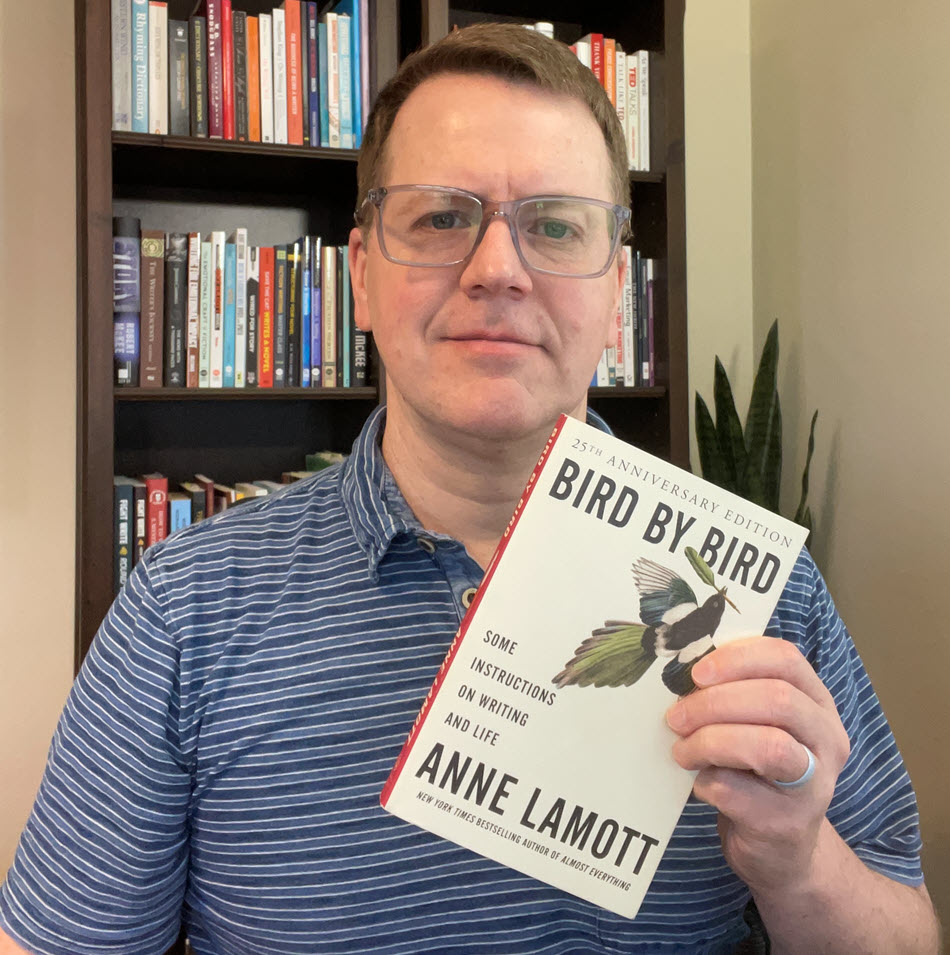
  • Bird by Bird by Anne Lamott
  • On Writing by Stephen King
  • Craft in the Real World by Matthew Salesses

Plus, some books about psychology and character traits, including:

  • Please Understand Me II by David Keirsey
  • The Positive Trait Thesaurus by Angela Ackerman and Becca Puglisi
  • The Negative Trait Thesaurus by Angela Ackerman and Becca Puglisi

Plus, some books on publishing, including:

Some of those books are more useful than others. I’m sharing video reviews of the ones I recommend most.

Why have I read so many books on novel writing?

While I’ve written five nonfiction books and nearly 4,000 articles and posts, I knew I didn’t know nearly enough about novel writing. I’d taken a couple of courses on it in college, but that was long ago and those were workshops rather than instructional. What I needed was a masterclass in novel writing, so I set out to create one for myself.

I started off with Hooked by Les Edgerton and How to Write Science Fiction & Fantasy by Orson Scott Card, both of which my eldest son gave as birthday presents. Then I bought a few more books on craft I found at Barnes & Noble. And then I started buying the craft books mentioned in the craft books I was reading, plus ones mentioned in articles I’d read.

Admittedly, some advice is repeated by multiple authors, but I’ve found that just reinforces what the fundamentals are. At the same time, truly unique advice and frameworks have stood out, especially once I got a dozen books in.

Both kinds of advice were helpful, since I was writing and revising my novels as I read these books on novel writing. As I read, I reflect on what I’ve written in previous chapters and whether it needs tweaking. Or I can adjust my outline for future chapters, which happened after I read The Fantasy Fiction Formula—which I highly recommend. 

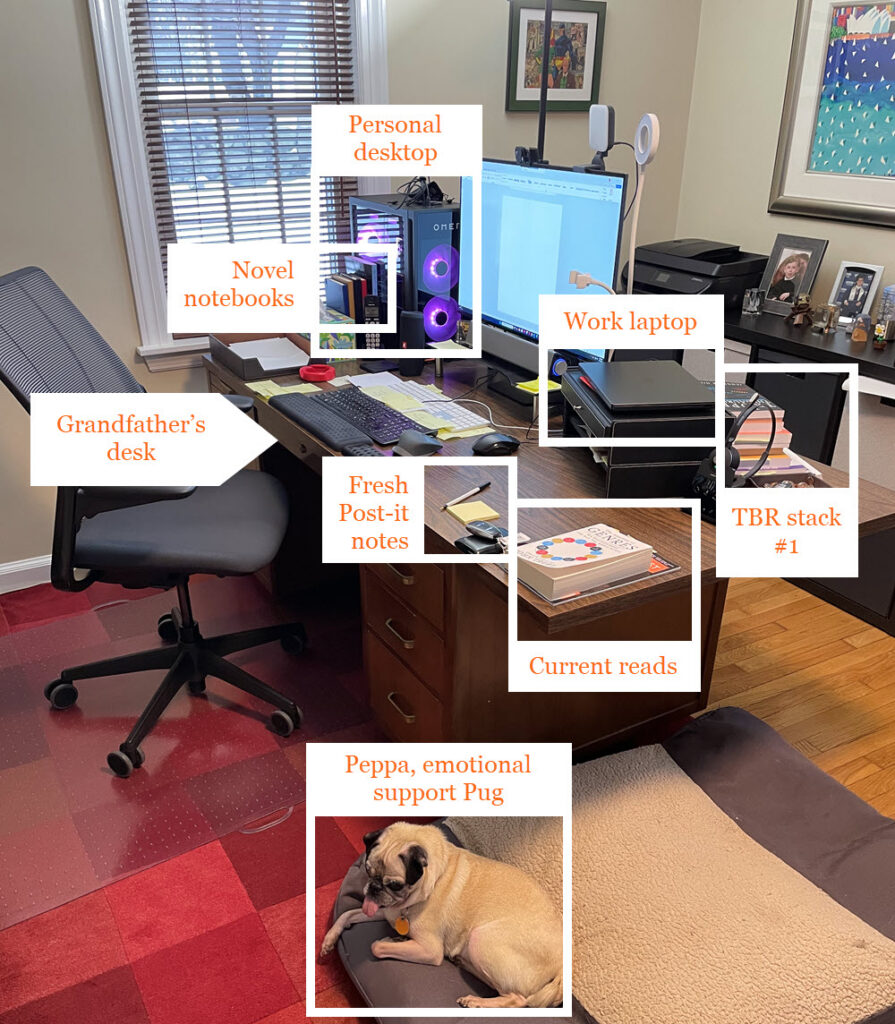
I’ve since read two more craft books, and I have six more in the TBR pile on my desk. Every one I read makes me a little better writer.

Some of the books on novel writing I’ve read

To receive future posts for free or to become a Patron and support my dystopian sci-fi novel and get special thank-you goodies upon its publication…

The Age of De-Skilling: Who do you want to be?

From the gramophone to compass to the computer, advancements in technology routinely cause people to abandon skills, says The Atlantic’s Kwame Anthony Appiah in The Age of De-Skilling (link to gift article). 

“It’s a reassuring pattern—something let go, something else acquired,” he says. “But some gains come with deeper costs. They unsettle not only what people can do but also who they feel themselves to be.”

Of course, AI is the next big advancement that’s causing the current cycle of de-skilling. The question is: What skills will people be giving up? And how will that impact their identity?

In these cycles, people have several paths available to them:

1. The cyborg

They can use the technology collaboratively, keeping their skills while gaining speed, precision, or other benefits from the technology.

2. The monitor

They watch over the technology as it does their former job, stepping in to assist when the technology falters. In this role, the person invariably loses skill and their former identity.

It’s around these two choices that most of the conversation about AI has revolved. Will you be the “human in the loop” that stays actively engaged in your craft? Or will you be the “human on the loop” that merely oversees and signs off on the work the technology does?

But I think there are two other options.

3. The innovator

Freed from some aspects of their profession or task, they specialize in one or more of the remaining aspects. In the age of AI, this means focusing on very niche subject areas where there’s relatively little domain knowledge—or, more commonly, being on the forefront of new discoveries. The innovator doesn’t compete with the new technology. Instead, they expand knowledge or pioneer new methods, which over time improve the new technology or fuel the next technology innovation. 

4. The artisan

Some people will continue doing things the old way. They will maintain their skills and identity, but compete directly with the new technology. In some cases, a critical mass of consumers will appreciate this human- or hand-crafted product or service, making it a viable choice. In other cases, there won’t be a viable market.

I recognize that not every person in every instance will have full discretion over which of these paths they take as AI spreads across industries. However, in my day job, I’m going to lean into being a cyborg and specialist, as that makes me the most valuable as a digital marketer. And in my night job as a novelist, I’m going to lean into being an artisan, as that best aligns with my values as a novelist.

The final paragraph of The Age of De-Skilling by Kwame Anthony Appiah in The Atlantic

Related posts:

Where to draw the line with genAI

Confession: I love em-dashes


To receive future posts for free or to become a Patron and support my dystopian sci-fi novel and get special thank-you goodies upon its publication…

Villains vs. antagonists

One of the questions my developmental editor asked me before taking me on was “Is there a villain or antagonist in your story? Who?” When I answered the question, I didn’t mention villains, only antagonists. That’s because I don’t think there are any true villains in my story, only characters who have desires that run counter to what the heroes want. 

In fact, I have three tiers of antagonists in my story:

  • Series antagonists, who drive the entire series
  • Book antagonists, who drive the action of each book (some series antagonists become book antagonists)
  • Threshold guardian antagonists, who present mid-book blocks our heroes must overcome to progress toward their goals (Threshold guardians are a character type discussed in The Writer’s Journey by Christopher Vogler.)

I like what Jack Anderson, the author of The Return of Moriarty, says about the differences between heroes and villains. In particular, I agree that while “heroes die for their beliefs, villains kill for them.” But I would add one more quality I think separates villains from antagonists: relatability.

DC Comics vs. Marvel Comics

There’s no better example of this distinction in action than the stories from DC and Marvel. DC features iconic villains like the Joker, the Riddler, Scarecrow, Two-Face, Bane, Lex Luthor, and Darkseid. Many of them are certifiably insane, while others are egomaniacal sociopaths and ruthless tyrants.

The Joker is insane, while Magneto is a zealous mutant rights advocate.

On the other hand, Marvel features iconic antagonists like Magneto, Thanos, Loki, and Kingpin. They’re bad and absolutely kill others in the name of their beliefs, but they’re not insane, two-dimensional characters. Their heinous actions stem from relatable worldviews, such as Magneto’s desire to protect mutants from racist persecution and Thanos’s desire to alleviate resource scarcity caused by overpopulation. These characters also have other redeeming characteristics, such as the ability to care for others.

If you’re into antagonists and protagonists who are rainbows of gray tones, rather than black and white cartoon characters of evil and good, then my sci-fi trilogy is for you.


To receive future posts for free or to become a Patron and support my dystopian sci-fi novel and get special thank-you goodies upon its publication, subscribe on Substack →

7 questions you should be able to answer before working with a developmental editor

When I was in talks to work with my developmental editor, Chersti, she asked a bunch of required questions about me, including my writing experience, my goals, whether I’m a plotter or pantser, and why I wanted to work with them. She also asked me seven optional questions about my novel.

While I didn’t have to answer them, I couldn’t help but feel like it would signal a lack of commitment if I didn’t—or a lack of confidence in my novel if I couldn’t. So, I invested the time to answer these very reasonable questions:

  1. What is the inciting incident of your story?
  2. What is your main character’s goal?
  3. What or who gets in the way of their goal?
  4. Is there a villain or antagonist? Who?
  5. What’s the hero moment during your climax?
  6. How many point-of-view characters are there?
  7. How many subplots are there?

Honestly, it felt great to be able to easily answer these questions. And that was despite the fact that the answers were complicated by having more than one POV character and my book being the first in a trilogy. For instance, there’s not only an inciting incident for the book, but also one for the series. Also, the POV characters each have their own goals and hero moments.

Those questions really get at the basic building blocks of a story, such as having a clear beginning and end, and having character conflict. In hindsight, if I hadn’t been able to answer those questions, I hopefully would have delayed moving forward with my developmental editor. Thankfully, I didn’t have to do that. Full steam ahead!


Related posts:

Recommended reading on novel writing from my developmental editor

My sci-fi novel is now in the hands of a developmental editor


To receive future posts for free or to become a Patron and support my dystopian sci-fi novel and get special thank-you goodies upon its publication… 

Book review: ‘The Writer’s Journey’ by Christopher Vogler

The Writer’s Journey is one of the core books in my writer’s library. Among other things, it provides a detailed discussion of the 12 parts of the Hero’s Journey. This popular story structure is found in many sci-fi, fantasy, thriller, and other stories, including cultural touchstones like Star Wars.

It also discusses 8 character archetypes, such as the hero, mentor, shadow, and shapeshifter. The book provides lots of examples of variations, so you can really understand the amazing richness of these archetypes.

I give The Writer’s Journey by Christopher Vogler 5 stars, 19 dog-ears, and 3 Post-its.

The Hero’s Journey

In my dystopian sci-fi trilogy (Project: T.A.G.), I make extensive use of the Hero’s Journey story structure. However, I don’t hesitate to mix things up. For example, my male protagonist has to face two challenges, or threshold guardians, to cross the threshold into act 2 of book 1.

Another protagonist, when faced with the call to adventure, refuses it repeatedly. Eventually, they face a refusal disaster, which is another twist on the standard formula.

The Hero’s Journey story structure from The Writer’s Journey by Christopher Vogler

Character archetypes

Every major character in my story has been assigned one of the eight archetypes: hero, mentor, threshold guardian, herald, shapeshifter, shadow, ally, or trickster. While I, of course, love my heroes, I’ve probably had the most fun writing the shapeshifters in my trilogy. 

My heroes aren’t perfect and my villains aren’t cartoon villains, but the shapeshifters are a step up in complexity. These characters aren’t just shades of grey, but actually change their colors over the course of the series. For that reason, these are the characters that will surprise readers the most.


Related posts:

Book review: ‘The Fantasy Fiction Formula’ by Deborah Chester

Book review: ‘Story’ by Robert McKee


To receive future posts for free or to become a Patron and support my dystopian sci-fi novel and get special thank-you goodies upon its publication

Tiffany Haddish: ‘Sharing is caring’

While she’s best known as a comedian, Tiffany Haddish is also the New York Times bestselling author of The Last Black Unicorn. On Thursday, I had the pleasure of hearing her talk about her latest book, I Curse You with Joy.

“When you say something on stage, they don’t always believe you. They think you’re making it up,” she said, adding that when you put it in a book, people assume what you’re saying is true.

Tiffany Haddish speaking at Zeta Live 2025 this week

Another difference between her standup work and her books is that her books give her space to tell some of her stories that aren’t funny. While she told the crowd to “find the funny” in their lives, she confessed she’s still trying to find the funny in some of the darker episodes of her upbringing as she bounced from foster home to foster home.

For example, when asked about the best gift she ever received, Tiffany Haddish said it was a suitcase she got from one of her foster parents. “I had all my clothes in garbage bags,” she said, “and I felt like garbage.”

She encouraged the audience to share their stories, even the tough ones, saying it makes people feel less alone. “Sharing is caring,” she stressed.

I couldn’t help but hear echoes of sportscaster and broadcaster Robin Roberts, who has encouraged people to “Make your mess your message.” It was that advice, in part, that led me to start writing my dystopian sci-fi trilogy, Project T.A.G., which is inspired by the loss of my daughter. Beyond a good story, I hope others can see that tragedy can be turned into something beautiful.


To receive future posts for free or to become a Patron and support my dystopian sci-fi novel and get special thank-you goodies upon its publication, subscribe on Substack →