Location scouting in Nashville

While I’ve travelled fairly extensively, I haven’t been to any of the locations where my dystopian sci-fi trilogy (Project T.A.G.) takes place. A number of those are in India and China, where I unfortunately haven’t been. Others are in out of the way locations in countries I have visited, such as Panama, Greece, and Finland.

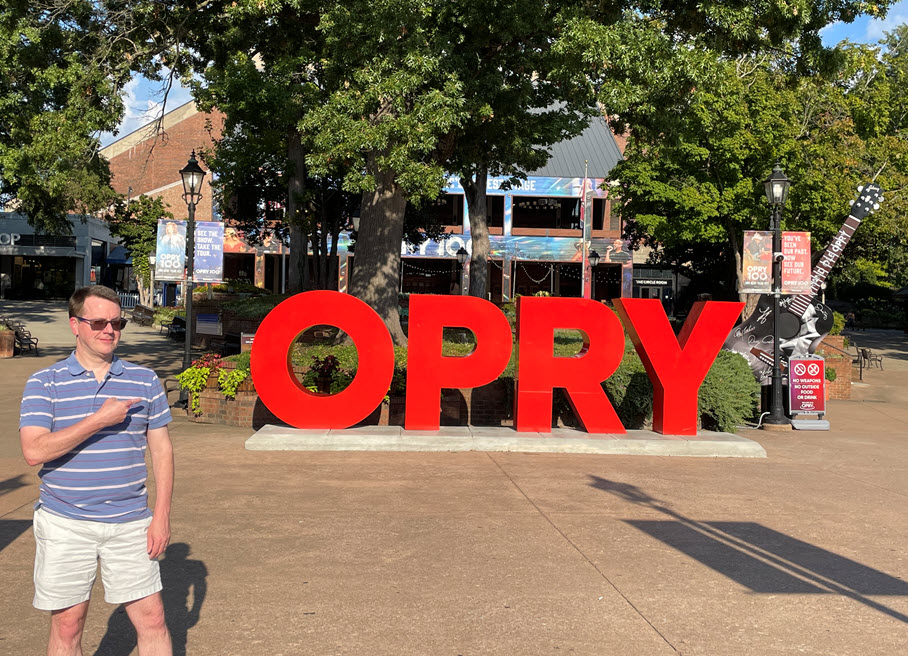
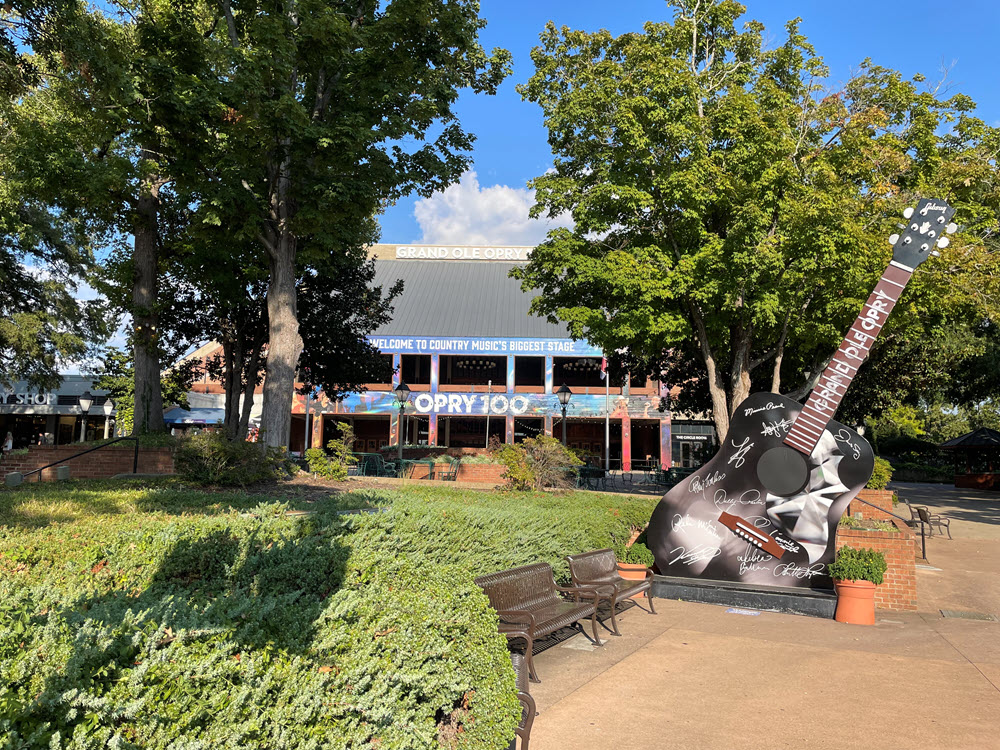
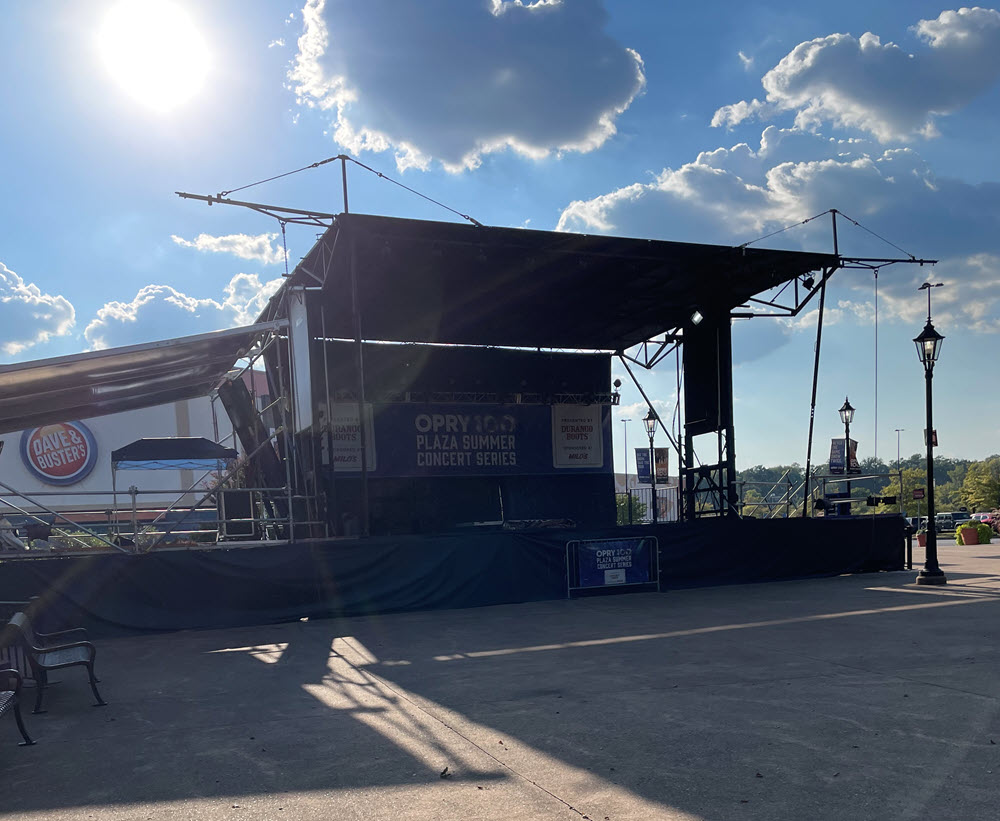
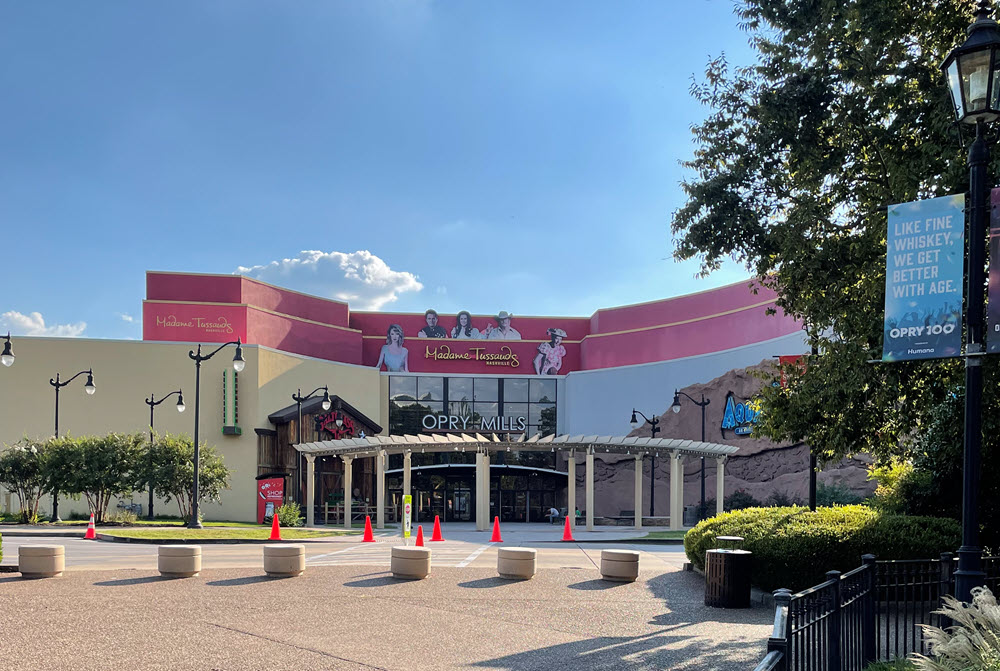
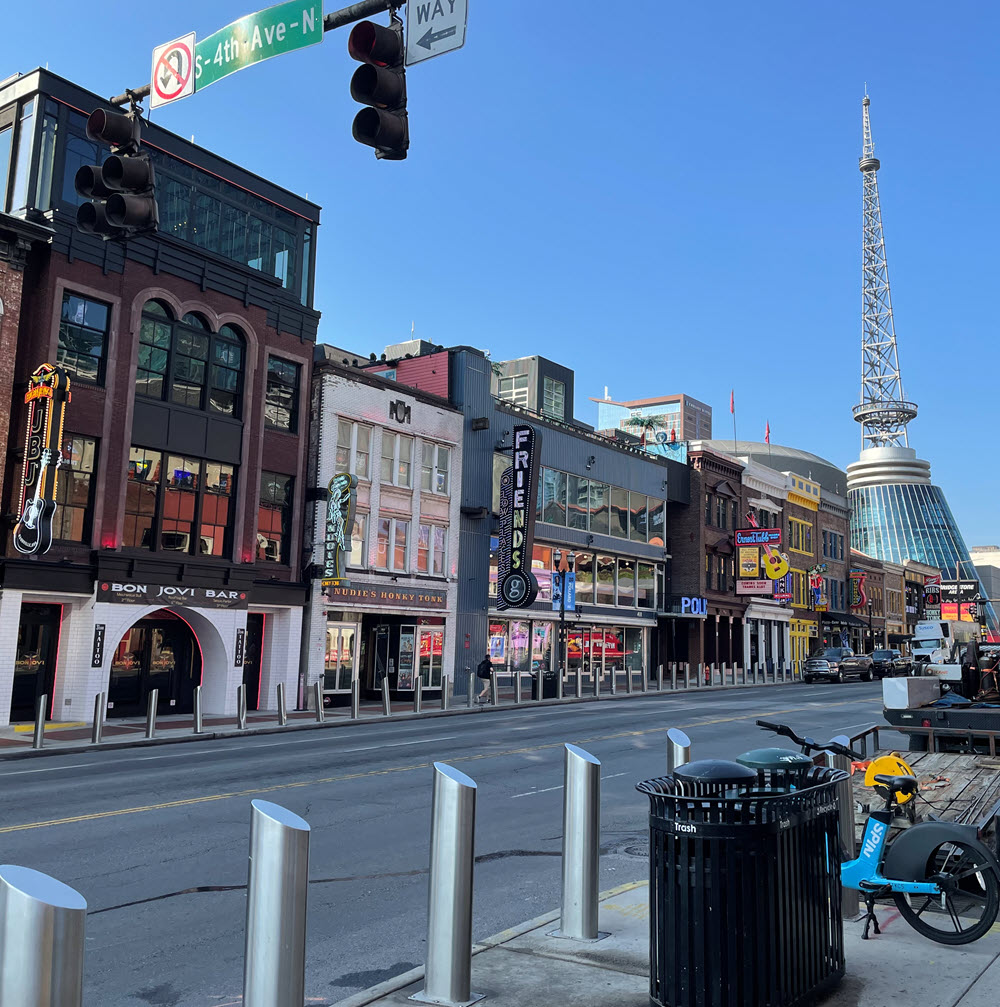
However, the sci-fi romance novel I’ll be working on next (Project W.A.) is based in part in Nashville. I hadn’t been there either, until this past week. As part of a road trip from Boston that also included Pittsburgh, Louisville, and Cincinnati, my wife Kate and I spent 24 hours in Nashville. We visited the Grand Ole Opry and Opry Mills, two locations that will be featured in my story. While we were there, we also spent time at the Country Music Hall of Fame, on the General Jackson Showboat, and on Honky Tonk Highway, a 4-block stretch of Broadway that’s packed with bars.

While I don’t think it’s necessary to visit story locations, it certainly can help give you a better sense of a setting and give you extra details that can bring more authenticity to your descriptions. It’s also more fun!


To get future posts… 

6 ways stories are NOT like real life

Ignoring the fantastical elements of sci-fi, fantasy, and horror, striving for realism in stories is seen as a must. After all, anything that breaks the rules of your world and of human behavior is likely to jar readers out of your story. That said, stories shouldn’t be too much like real life, because unfiltered real life doesn’t generally make for good stories. Here are 6 ways that’s true:

1. Characters

Many writers base some of their characters on real-life people, including themselves. That’s obviously fine, and probably unavoidable. But too much fidelity invites problems (besides potential libel suits), because characters are meant to be so much better than real people.

“A character is no more a human being than the Venus de Milo is a real woman,” says Robert McKee in Story. “A character is a work of art, a metaphor for human nature. We relate to characters as if they were real, but they’re superior to reality. Their aspects are designed to be clear and knowable; whereas our fellow humans are difficult to understand, if not enigmatic.”

I have 25 pages of notes on the characters in my dystopian sci-fi trilogy, including more than a page about each of the major characters. They’re detailed, but all the details create an intentional effect, with no extraneous information to distract.

2. Dialogue

When you’re trying to improve your dialogue, eavesdropping on people in public isn’t nearly as educational as you might think, as Deborah Chester points out in The Fantasy Fiction Formula.

“The trouble is that most real-life conversation is meaningless, aimless social chatter,” she says. “It seldom gets to the point. It’s frequently boring, especially to listeners who aren’t participating. Real-life talk is filled with pauses, fumbling for words, fragments, gaps supplemented with gestures, and slang. When you try to copy any of that too closely in your fiction, you may find yourself stalled. Aimless dialogue keeps scenes from developing properly. Plots can’t move forward. The pacing lags.”

As a former journalist, I learned this lesson long ago. Even when you’re interviewing someone or they’re presenting on stage, unless they’re highly practiced, what they say is often full of imprecision, with lots of starts and stops and tangents, which is generally fine and doesn’t hurt basic comprehension. But we have much higher standards when it comes to the written word.

3. Accents

Related to dialogue, accents can be a real momentum killer—even a bit of a book killer. For instance, I’m a fan of Iain M. Banks’ sci-fi novels about the Culture, an advanced interstellar civilization. I’ve read almost all of them, except for Feersum Endjinn. It’s sitting on my bookshelf with a bookmark at the start of chapter 4. That’s as far as I could make it, because one of the POV characters speaks phonetically and it was just too much effort to slog through. Based on reviews, I wasn’t the only one that struggled with it.

So, take the advice of Hallie Ephron, who says in Creating Characters that “More than a touch of phonetically rendered dialect can be distracting and difficult to decipher. Not only that, dialect can turn character into caricature. Use the occasional phonetic version of a phrase to give the reader the flavor of how a character sounds, but do so sparingly. Trust the reader to mentally apply what you suggest to the remaining dialogue.”

In my sci-fi novel, I use dialect very sparingly, instead relying on other speech patterns and word choices to differentiate characters, as well as some local colloquialisms. I found Russian colloquialisms to be among the most amusing, including “balls of a swan,” which is an expression of surprise and disbelief. I also have a character who’s routinely drunk and he slurs his words, but his sentences are short and there’s plenty of context to move things along. 

4. Signal-to-noise ratio

Most people’s lives are full of lots of conversations and events that don’t have much or any impact on their lives. The lives of characters have to be much tighter, with a very high signal-to-noise ratio.

“Our assumption is that if we don’t need to know it, the writer won’t waste precious time telling us about it,” says Lisa Cron in Wired for Story. “We trust that each piece of information, each event, each observation, matters … If it turns out that it doesn’t matter, we do one of two things: (1) we lose interest, or (2) we try to invent a consequence or meaning. This only postpones our loss of interest, which is then mingled with annoyance, because we invested energy trying to figure out what the writer was getting at, when the truth is, she wasn’t getting at anything.”

This is where editing comes in, and can be painful. This is where we kill our darlings that aren’t pulling their weight.

5. Clear goals

In real life, people’s goals are often unclear—sometimes even to themselves. But in stories, readers need to know what the protagonist is trying to achieve. Knowing the antagonist’s goal is also helpful.

“When our protagonist has a strong goal,” said Cae Hawksmoor in a recent issue of her Pagewake newsletter, “it’s like entering a destination into the GPS of our story. All of a sudden, the readers know where they’re going and can judge the main character’s progress.”

Of course, goals can change. In my trilogy, the goals of my three main characters change from book to book, as well as throughout each book as their circumstances change (generally for the worse). In Robert McKee’s Dialogue, he would refer to those more short-term goals as motivations or scene intentions. However, the core long-term need of each of my main characters doesn’t change over the course of the series. McKee refers to that as their super-intention.

6. Nothing is by chance

The human experience is intensely random. One of the reasons people read books is to escape that randomness. Readers like to see worlds that are orderly and follow rules, and characters who are able to exert some control. And while bad things can sometimes happen randomly, readers really don’t like it when good things happen randomly. “Deux ex machina!” they’ll cry. Readers want to see characters as the change-agents of their own lives and the lives of others. They don’t want to see acts of god.

Generally for the better, my characters make choices that have big impacts on those around them and ultimately the world. Those choices often come at a great personal cost. 


To get future posts… 

Confession: I’ve written all my books in Microsoft Word

For my day job, I write almost everything in Google Docs, because of the easy sharing and collaboration. But I’ve always written my books in Microsoft Word. Back in 2011 when I started writing my first book, I looked at Scrivener, which was the No. 1 book-writing tool at the time. I wasn’t that impressed.

Today, I know there are many more alternatives to Word, including Atticus, Bibisco, Living Writer, Squibler, and Ulysses. (Kindlepreneur has a good comparison article.) But I’m still skeptical about whether any of them are worth it.

I’m not into timers. Too stressful.

Drag-and-drop chapters and sections? Copy and paste work just fine.

And I know that word count goals are a big deal to many, but they’re not for me. I feel just as fulfilled when I complete some key research, cut 100 words, or do some other vital task that doesn’t rack up the word count. 

Word seems good enough-ish

Even though Word’s spelling and grammar checks are absolute garbage, it offers extensive formatting options and plenty of organizational hacks. For instance, I use headers for each chapter, and then keep the Navigation pane open to easily jump to a particular chapter. In that header, I include the chapter number, the latest word count, and a one-line description of the chapter’s action.

And then when it comes time to share with an agent or editor, Word is the format everyone expects.

Am I missing out?

Writers, if you use something other than Microsoft Word, what do you use and do you like it? What features do you find the most indispensable? Please comment and let me know.


To get future posts… 

Book review: ‘Story’ by Robert McKee

Don’t be fooled by the fact that the subtitle of this book includes the word “screenwriting.” This book is for anybody who wants to understand storytelling at a deep, technical level. 

It covers story structure, down to the level of beat. Idealist, pessimist, and ironist controlling ideas. Character development and inner, personal, and extra-personal conflicts. How to handle the inciting incident. Designing acts and scenes. Selecting your cast of characters. And all with great examples from famous films you’d likely seen.

If I were creating my own masterclass on creative writing, this would be one of the core books.

I give it 5 stars and 13 dog-ears and 4 Post-its.

Essential story building blocks

In Story, there are two concepts that were particularly helpful to me as I’ve been writing my sci-fi trilogy. The first concept is that beats create scenes, scenes create sequences, sequences create acts, and acts create stories—with each of those marking a change. The beats mark changes in action/reaction, with those culminating in the turn of a scene, with those culminating in a final scene of a sequence that has a greater impact than the earlier scenes in the sequence … and so on, with acts culminating with the biggest changes.

All that’s to say that with every beat, scene, sequence, and act turns on a change of fortune for one of the main characters, either for better or worse. The more reversals the better, since those are usually born out of conflict and make for more of an emotional rollercoaster. That may seem intuitive, but keeping this top of mind has really helped me avoid flat scenes that don’t affect the characters.

One of my favorite scenes in the second book in my series features three worsening beats for the male protagonist, then two improving beats that has him looking on the bright side of things—only to have the chapter end the sequence with a full reversal of his fortunes, where he actually gets the thing he initially wanted but now no longer wants. Then the next chapter starts with it getting even worse. It’s a torturous ride and a lot of fun!

The negation of the negation

And the second concept is the Negation of the Negation. McKee explains it like this:

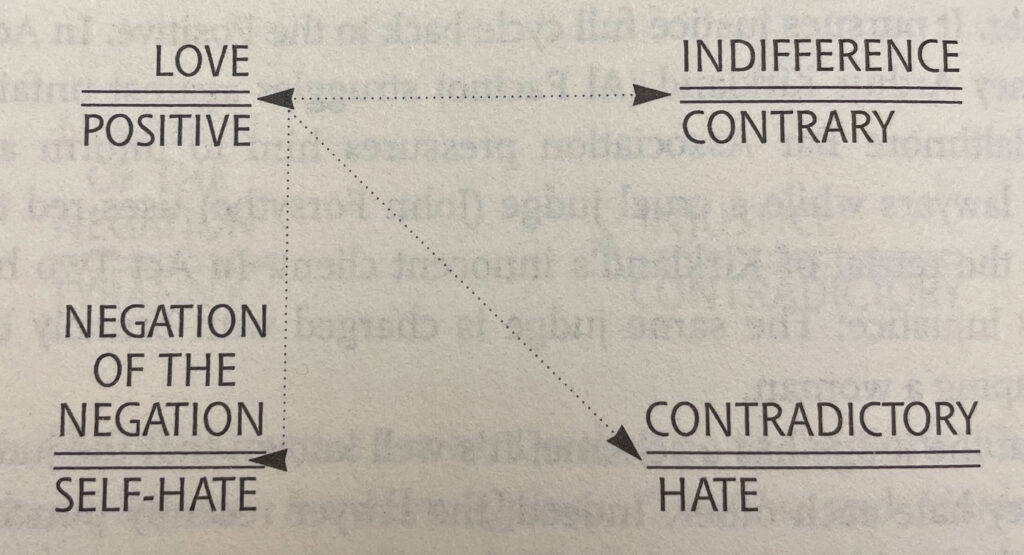
“A story that progresses to the limit of human experience in depth and breadth of conflict must move through a pattern that includes the Contrary, the Contradictory, and the Negation of the Negation. … Negation of the Negation means a compound negative in which a life situation turns not just quantitatively but qualitatively worse. The Negation of the Negation is at the limit of the dark powers of human nature.”

Positive: Love
Contrary: Indifference
Contradictory: Hate
Negation of the Negation: Self-Hate

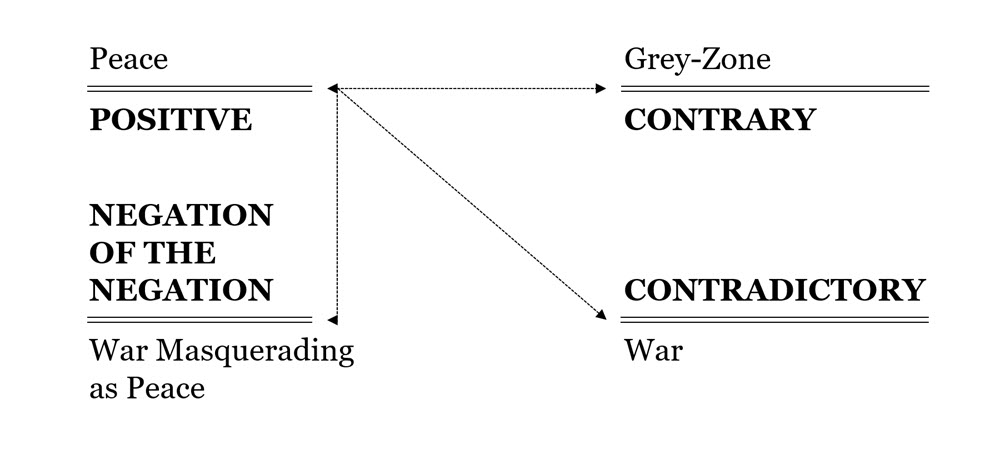
My takeaway is that love vs. hate, for example, is too black and white. The Negation of the Negation is a more interesting twist on hate, such as self-hate or hatred pretending to be love. I got really excited when I read about this, because it turned out my sci-fi trilogy already leveraged this concept, as the overarching extra-personal conflict is a war that’s masquerading as peace.

Positive: Peace
Contrary: Grey-Zone
Contradictory: War
Negation of the Negation: War Masquerading as Peace

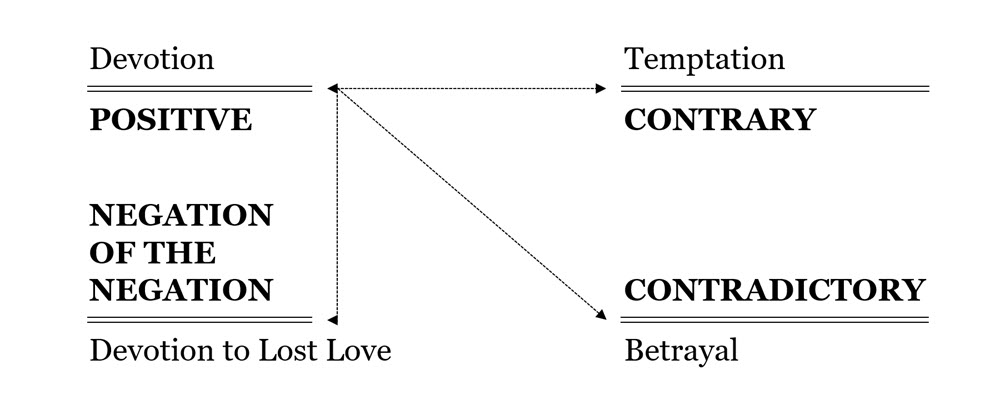
And a separate novel idea I’ve been outlining and amassing notes about involves a devotion to love lost that keeps the protagonist from moving forward with their life.

Positive: Devotion
Contrary: Temptation
Contradictory: Betrayal
Negation of the Negation: Devotion to Lost Love

The Negation of the Negation is a fascinating concept that I’d never encountered anywhere else. If you’re working on your own story, see if you can fit it into this square of Positive, Contrary, Contradictory, and Negation of the Negation themes. It might show you how to uplevel your theme. It’s also fun to brainstorm potential squares as a starting point for a story.

And for all of you non-writers, it’s a concept that you’ll find in some of your favorite, most-gripping stories now that you know what to look for.


Related posts:

Book review: ‘The Fantasy Fiction Formula’ by Deborah Chester

Book review: ‘The Writer’s Journey’ by Christopher Vogler


To get future posts… 

How to generate writing momentum

Writing is hard. It’s gratifying to finish a scene or chapter you’re really proud of, but all the time spent getting up to that moment is difficult. As Stephen King argues in his book, On Writing, completing a novel is a game of momentum. That’s why when he starts on a new novel, he has a strict schedule where he dedicates himself to finishing the book in 3 months or so by writing and editing many hours each day.

I remember being incredibly despondent when I read that. I’m glad that Stephen King has the ability to do that, but I don’t. I’m not a multi-millionaire. To help support my family, I have a full-time job, which I happen to really like. And I have 3 kids, two of which are still at home, and one of which has special needs. Between therapy for kid 1 and piano lessons and jazz band for kid 2, and then making dinner and taking care of the house and myself, I’m feeling pretty fortunate if I have 2 hours a day to write on an average weeknight. Plus, I dedicate one entire evening a week to spending time exclusively with my wife, which has served our 19-year marriage very well. 

Weekends are usually better for writing, but there’s still a lot to balance—and I want to balance all of those things because they’re all important.

But the issue of momentum remains. I do agree with Stephen King that it’s important to have it, and if you can’t get it by going fast, then there’s only one other way to get it.

The Other Way to Generate Writing Momentum

Since momentum is velocity times mass, scientifically speaking, the other way to generate momentum is to have mass. Literarily speaking, that means you need to have an idea you’re really passionate about.

Honestly, I didn’t have that in college which is when I attempted to write my first novel. It was about 40 space colonists who all collectively have the same dream over and over of landing on their target planet and setting up their colony ahead of others arriving years later. It was a way of using the cryosleep for training, so that when they finally arrive they’ll be incredibly well-trained and efficient. But one of the colonists falls in love with another and is rebuffed by them. Spurned, the colonist acts out by killing all of the colonists, causing the cryosleep simulation to reset. Long story short, this pattern repeats itself over and over to the point that the spurned colonist doesn’t realize it when they actually arrive on the planet and continues their killing spree, dooming the colony. Pretty dark, I know.

Despite working on it for many months, I never finished it—partially because I got bogged down in the mushy middle—but more so I think because I never had a strong stake in the story. It was an interesting idea, but there wasn’t anything uniquely me in it. And at the time, I don’t think I had the emotional maturity to be introspective enough to make that kind of investment.

More than a decade later, I was at a digital marketing conference and one of the inspirational speakers was sportscast and broadcaster Robin Roberts. She was great and her main point was to encourage people to use their personal struggles for good. She said, “Make your mess your message.”

My Mess Has Become My Writing Momentum

It’s taken me a while to act on that, but that’s what I’m trying to do now with my novels. The dystopian sci-fi trilogy I’m working on is inspired by my daughter, Samantha, who would be 18 years old if she were alive today. We lost her in the third trimester when my wife suffered a splenic artery aneurysm, which means the artery to her spleen exploded.

When that happens, it’s fatal to the baby 90% of the time and fatal to the mother 70% of time. My wife got very lucky. Our daughter didn’t.

My sci-fi trilogy is about a family decades in the future that suffers a similar loss, but the daughter that is thought to be lost isn’t dead. While separated from her parents, she becomes—after many struggles—a badass. She’s the heroine of my story and, together with her partner, she saves the world from a horrible fate.

The other novel ideas I’m developing have equally personal cores that drive those stories and drive me to finish them, too. Thanks for joining me on this journey.


To get future posts… 

Book review: ‘Fight Write’ by Carla Hoch

Fight Write by Carla Hoch is fantastic for any author who wants to write a believable fight scene, whether it’s with guns, blades, or fists—especially if, like me, you’ve never been in the military or mastered a martial art. But, honestly, even if you have, you’ll find this book valuable.

First and foremost, it’s a great reference guide, detailing different fighting styles, attacks, melee weapons, guns, and more. But as much focus as there is on creating a credible fight, Carla also focuses on the build up to the fight and the aftermath. Those have to be credible, too. So, there are discussions of intimidation and posturing, as well as post-fight injuries. She also has a number of interviews sprinkled throughout that bring more visceral first-hand accounts of fight-related experiences.  

I give it 5 stars, and 12 dog-ears.


To get future posts… 

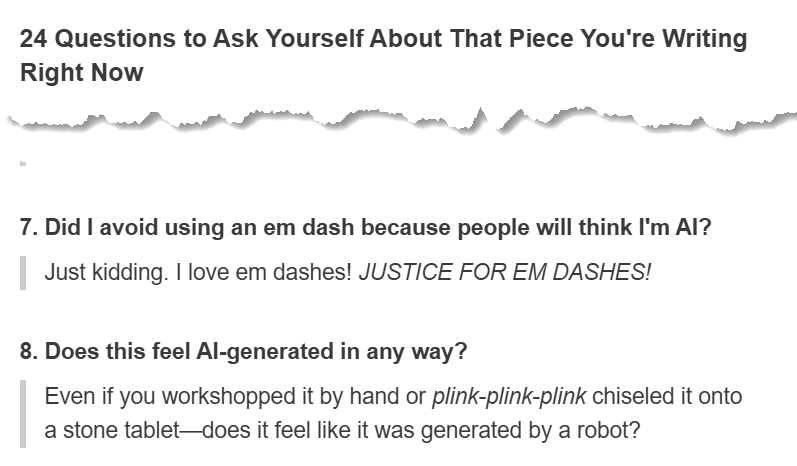
Confession: I love em dashes

Because generative AI engines like ChatGPT use them a lot, some writers are starting to reconsider their use of em dashes (which are so named because they’re the width of a capital M). I get it. No one wants to be accused of using genAI when they didn’t. 

But the fact that genAI produces copy with a healthy number of em dashes only means that em dashes are well-represented in their training material, and are therefore a staple of good writing. Cutting the versatile em-dash from your writing will only leave it worse off.

For what it’s worth, I use them all the time in my business writing. Heck, there are five in my latest article for CMSWire. And in the draft of book 1 of my sci-fi trilogy, I have more than 600 em dashes. That comes out to one about every 150 words on average.

That may sound like a lot, but I use them …

  1. When a character’s speech is interrupted—by another character, a door slamming, or an explosion
  2. When a character stutters when they’re flustered (e.g., “I— I think”)
  3. For labored speech, like when they’re out of breath
  4. When a character’s thoughts are labored and fractured, like before they pass out
  5. To offset a clause more emphatically than a comma can
  6. For asides in speech, instead of using parentheses
  7. Before a list, instead of using colon

Beyond that, they’re just a fantastic tool for controlling the rhythm of a sentence. So, no matter what genAI spits out, I’m going to keep using em dashes. And for the record, I’m going to keep using periods and commas, too, even though those are also suspiciously common in genAI copy.

From Issue 192 of Total Annarchy, a wonderful newsletter by Ann Handley

Related posts:

The Age of De-Skilling: Who do you want to be?

Where to draw the line with genAI


To get future posts… 

Where to draw the line with genAI

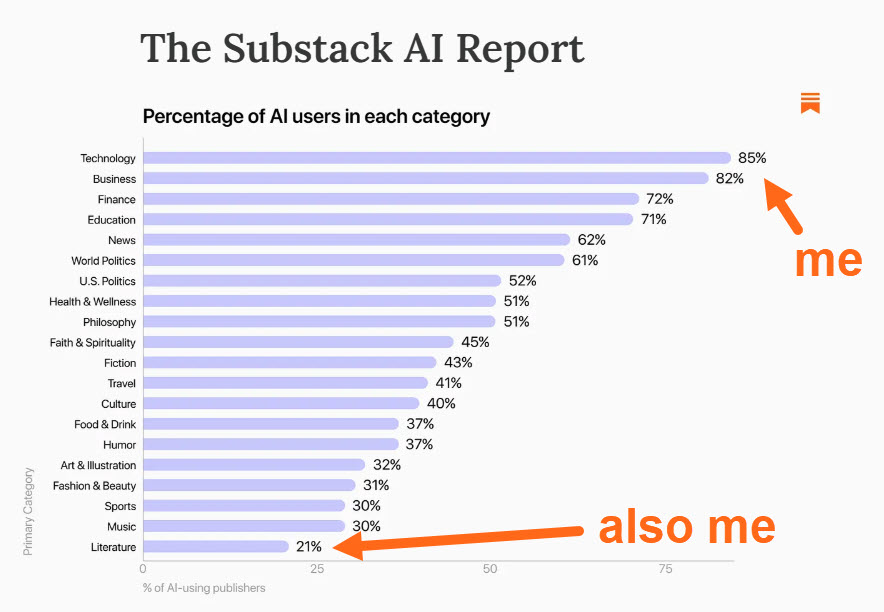
I’m a member of the group that’s most bullish on generative AI and the group that’s the least. That’s because I’m a marketing strategist at a tech company by day and an aspiring novelist by night. The latest survey from Substack illustrates the extreme divide between these two groups.

Wearing both of these hats, here are major issues I see:

  1. Anything created substantially using genAI can’t be copyrighted. (And if governments are smart, that will never change.) This is why agents and publishers want to know if you’ve used AI in your book, because it could potentially zero out the commercial value of your book. AI-generated images for covers are similarly problematic.
  2. Using genAI opens you up to plagiarism lawsuits until the law gets settled here, which could take years. This is why some of our Fortune 1000 clients write into our agency service contacts that we can’t use genAI for any of the work we do for them. They don’t want the legal risk since they’re big legal targets already. The Big Five publishers surely feel the same way.

Of course, many writers feel genAI is morally wrong because it’s essentially a plagiarism engine. And their minds won’t change even if the courts rule that genAI’s use of copyrighted material is transformative (which is highly likely to happen).

But putting those feelings aside for a moment, let’s recognize that some genAI uses don’t run afoul of those two issues above because they’re noncommercial. For example, turning your human-authored book summary into social media posts to promote your book. Or creating AI-images of your protagonists based on the descriptions in your book to use on social. Or taking the short author bio you wrote for your jacket copy, adding a bunch of details, and having genAI draft a long bio for your website.

Let’s also acknowledge that genAI is a huge boon for people with dyslexia and ADHD, as well as non-native English speakers.

All of that said, I’ve made the personal decision not to use genAI in any way for the writing of my novels, including AI-infused editing tools like Grammarly. At the end of this very long road, for better or worse, I want to be able to take full credit (along with my editors and beta readers) for everything in my novels, including the human imperfections.


Related posts:

Grammarly’s Expert Review debacle

The Age of De-Skilling: Who do you want to be?

Confession: I love em dashes


To get future posts… 

Join me on my writer’s journey from nonfiction to fiction

Hello, everyone! I’m an aspiring novelist looking to connect with avid readers and other writers, especially in the genres of science fiction and fantasy. On this blog, I’ll discuss writing and publishing, and share the ups and downs of my writer’s journey to get my first novel published.

A little about my debut in-progress novel: I’ve made things extra hard on myself by making my first effort a 3-book dystopian sci-fi series set in a war-torn near future. My two heroes are new adults (18 and 19 years old) and the story revolves around them finding their places in a world where the two global superpowers are in an uneasy peace. The story also revolves around our two heroes finding each other and coming to terms with their broken families.

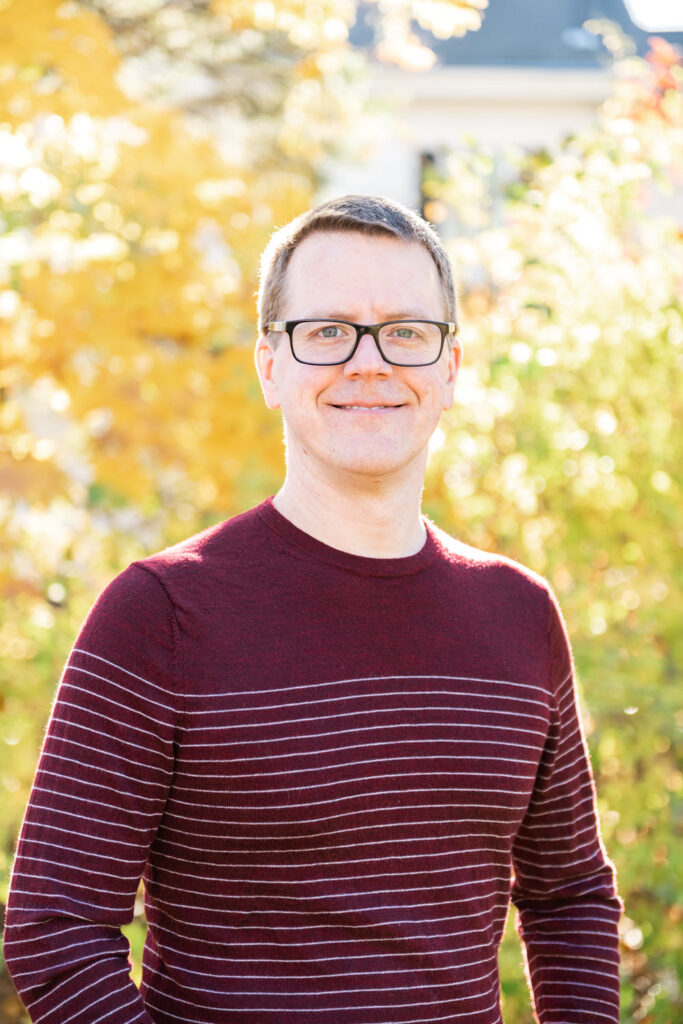
A little about me: I’m a tech industry veteran and former journalist who’s written five non-fiction books about digital marketing. As part of my day job, I’ve also written nearly 4,000 blog posts and articles about marketing, AI, and other topics. I’ll occasionally talk about my non-fiction book writing experiences, as those have given me the confidence to take on novel writing.


To get future posts…