How to Write a Mystery contains contributions from 73 authors—some of which are essays that are several pages long, while others are a single page or even a single sentence. This allows the book to cover lots of ground, addressing both general novelist issues and, of course, mystery-specific topics.
For instance, it has a great essay by Naomi Hirahara about the pros and cons of different kinds of amateur sleuths. I love a good list. And it has a one-pager by Robert Lopresti about the Rising Island method of writing a novel, which is for folks who are halfway between being a pantser and plotter.
Even if you have no interest in writing a straight-up mystery novel, you’ll find useful advice in this book. I give it 5 stars, 9 dog-ears, and one Post-it.
Things I dog-eared and Post-it’d include:
Naomi Hirahara’s list of different kinds of amateur sleuths (i.e., lawyer, parent of young children, clergy, journalist, and 10 others), including their superpower, challenges, and advantages, along with examples from literature
Susan Vaught’s breakdown of mysteries for different age groups
Chris Grabenstein’s advice on having a diverse cast of characters, and the popularity of “Own Voice” stories
Kelley Armstrong’s tips on profanity, including making up your own in fantasy worlds
Robert Lopresti about the Rising Island method of writing
Greg Herren’s advice on accents and regionalisms (which is essentially that a little bit goes a long way)
Maddee James’ advice about what to include on your author website
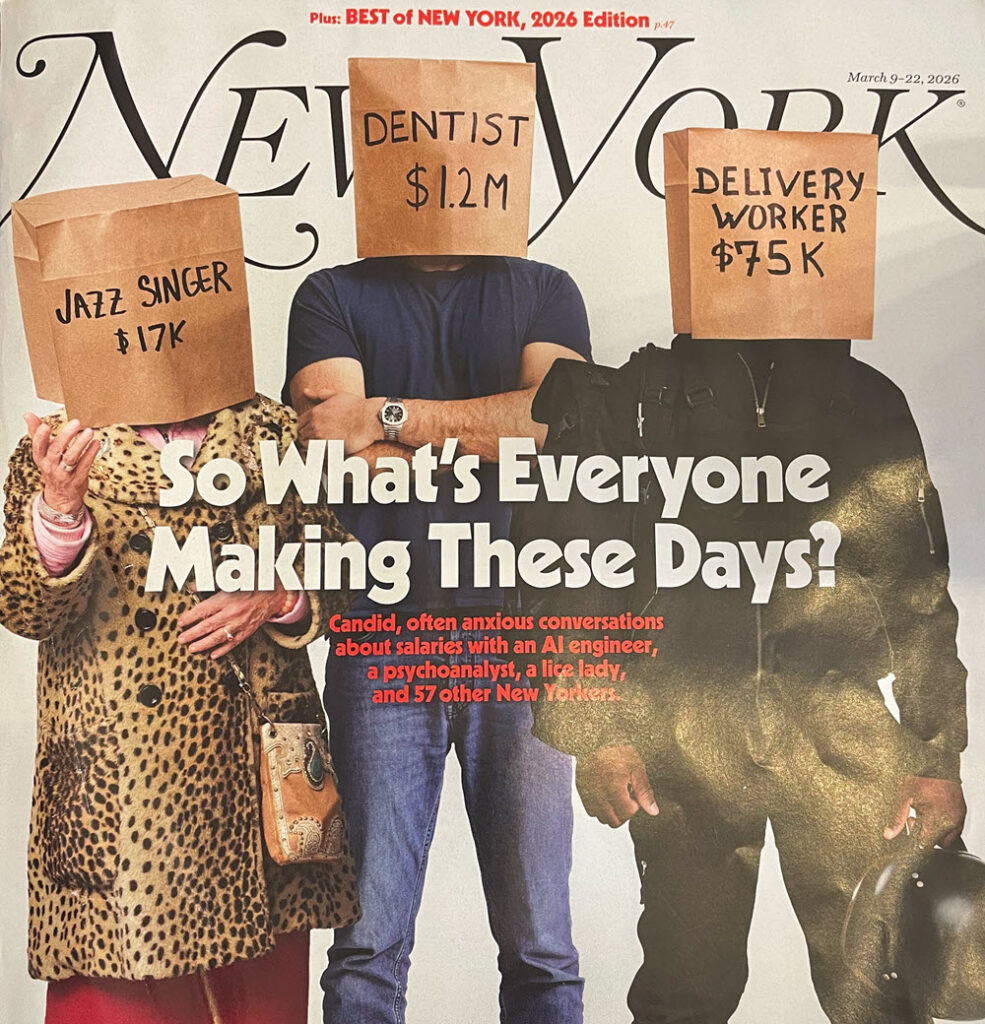
The cover story for the March 2026 issue of New York Magazine is What Do You Do and What Do You Make? Perhaps because I have two high schoolers, I found it fascinating to see what people in different professions make. I also couldn’t help but think about how AI and other changes are shifting the prospects of various careers.
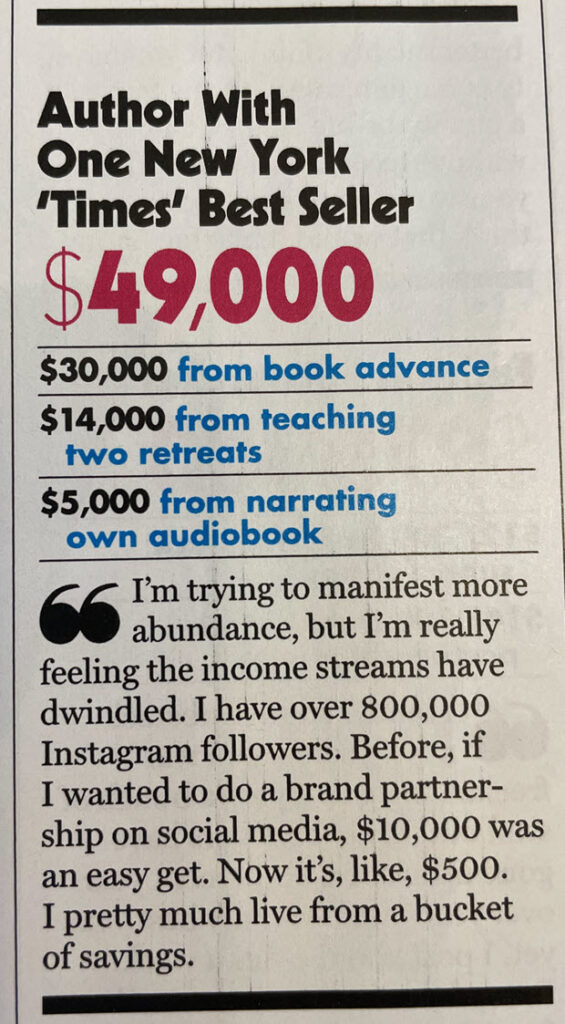
But the item that most jumped off the page for me was this spotlight on an author with one New York Times’ bestseller, who’s living partially off his savings.
I found that super discouraging—that even an author who had broken through with a NYT bestseller was struggling. That doesn’t say anything good about the publishing industry or book-reading in our society.
While my own novel-writing aspirations are modest and squarely a side-hustle that I’m serious about but not banking on, it makes me sad to know that writing novels as a career seems to be slipping out of reach for more people.
I can’t help but think of the old and rather mean-spirited adage: “Those who can’t, teach.” Increasingly, when it comes to novel-writing, a more accurate adage would be: “Even those who can, teach … and edit … and have second jobs.” I wish that weren’t the case.
After having little success querying agents, I decided to work with a developmental editor, which was a fantastic decision. After working on revisions for 5 months, now it’s in the hands of a copy editor.
Book 2
📕 Draft complete!
✍️ 100,000 words, 27 chapters
▶️ Goal: Finish revisions and start working with my developmental editor by the end of the year ✍️
I learned a ton working with my developmental editor on Book 1. I need to apply those learnings to Book 2—and reflect a few plot tweaks—before giving it to her.
Book 3
📘 Work in progress…
✍️ 45,000 words, 15 chapters
▶️ Goal to finish draft by end of 2027
I had originally hoped to finish this draft by the end of last year, but I’ve been doing so deep in revisions on Book 1 that I haven’t done any more work on Book 3. And now I want to go back to Book 2 and apply what I’ve learned, so finishing Book 3 is on the backburner for now.
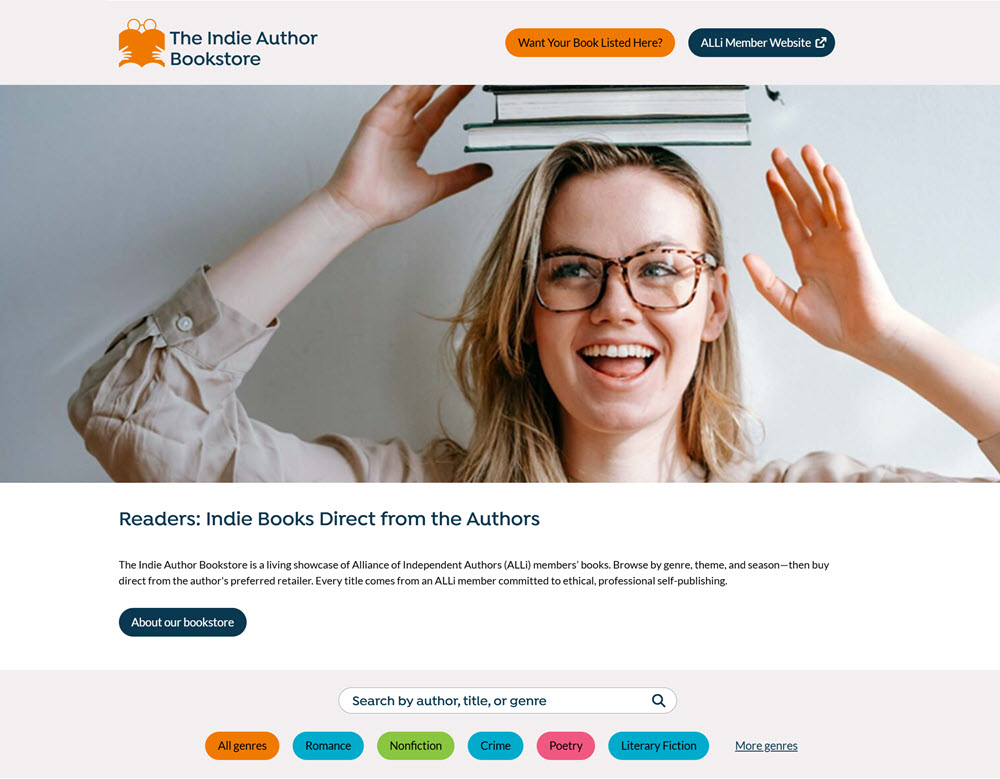
Indie-published books now make up a substantial portion of the book market. For instance, indie titles represented half of the top 400 books sold on Amazon during 2024. With April being Indie Author Month, there’s no better time to discover your new favorite author. And with the Alliance of Independent Authors’ newly launched Indie Author Bookstore, there’s no easier way to find your next indie read.
The Indie Author Bookstore allows you to search by author and title, and explore by genre. It also spotlights new releases, as well as daily featured titles.
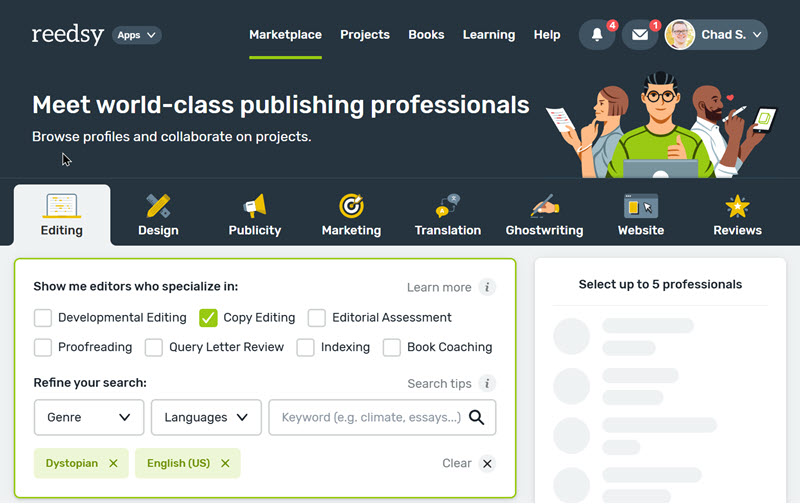
After nearly 6 months of revisions while working with my developmental editor, I’ve now handed my novel off to my copy editor, Jon, which I also secured via Reedsy.
What they’re doing
The scope of work includes:
Identifying and correcting any spelling, grammar, factual, and formatting errors
Editing to ensure the consistency of the prose and the clarity of the narrative
Supplemental materials
To aid in this effort, I supplied them with:
A character list
A timeline of major events, including dates
A glossary of 27 terms, including neologisms and other words and phrases that have a unique meaning in my book world
A style guide that specifies the verb tense used throughout the novel, the fonts used, and the styling of internal dialogue, recalled dialogue, official titles, song and book titles, etc.
Scheduling
In an effort to give myself some extra motivation, and because editors schedule months in advance, I booked both my developmental editor and copy editor at the same time. I kicked off work with my developmental editor in November of last year and got my manuscript back (with editorial letter, etc.) in mid December. And I assumed that I’d be able to turn around the edits by the beginning of March. I was wrong.
I had to push the start of copy editing back a month. Thankfully, I recognized the need early enough that my copy editor was able to switch my scheduled block with another client. Even with the start date pushed back, I was rushing. I suspect there are some additional errors because of the speed of revisions. I guess we’ll see.
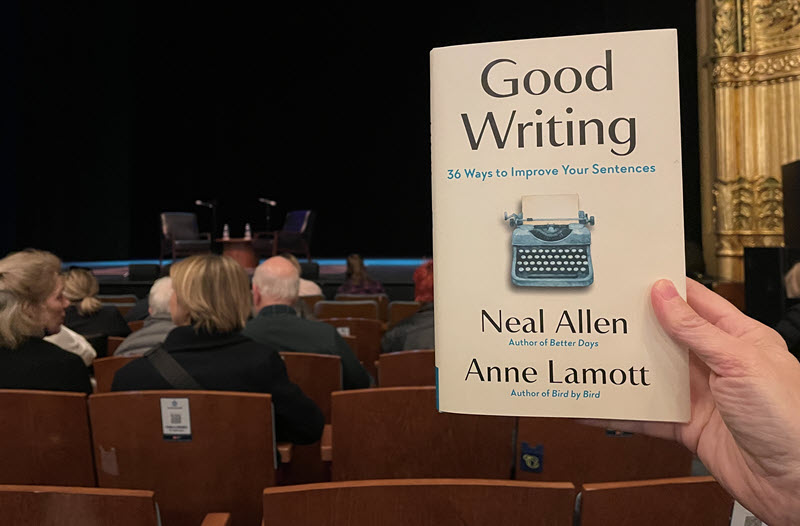
As a 20th wedding anniversary gift, my wife Kate got us tickets to see Anne Lamott and Neal Allen talk about Good Writing: 36 Ways to Improve Your Sentences, which they wrote together. Since Kate and I have published seven books between us, and have aspirations to write more and eventually co-author a novel, we were curious about them as a writing duo. I was also curious about their thoughts on the issues of the day, and since the audience could submit questions, I asked them and was fortunate enough to have them pick my questions.
Moments before Anne Lamott and Neal Allen took the stage to discuss Good Writing and answer audience questions
Social media & book reviews
In response to my question about how social media has changed in the publishing industry, Lamott said, “There are no more book reviews in the world. It’s all social media.”
She added that Good Writing was her 21st book and her first launched with no book reviews. “You have to create a platform.”
That’s sobering advice for every writer who hates social media and platform building.
The role of artificial intelligence
Along with many others, I asked about their views on artificial intelligence. Neither of them was interested in using it for writing, with Lamott joking, “I don’t know how to operate a toaster.” Allen said he wasn’t tempted to use AI for writing because the writing is the part he enjoys. Later, he would say, “It’s only through writing the book that I discover what I don’t know.”
That said, both Allen and Lamott were in awe of AI. It has not only read every novel, said Allen, but all literary criticism. “AI is going to be the authority.”
At times, Lamott sounded downright fatalistic about AI. A Sunday School teacher until recently, she said she asked ChatGPT to write a Palm Sunday talk “in the style of Anne Lamott” and confessed that it was “exquisite.” She concluded, “There’s no reason for me. It can write me.” That statement alarmed the audience.
“I think there will be guilds like there were in the Middle Ages,” added Lamott, who’s concerned about the impact AI will have on her son and grandson. “There will be people huddled together escaping AI.”
The purpose of writing
While that sounds dystopian, both Lamott and Allen see writing as a personal endeavor first, an interpersonal endeavor second, and a community endeavor last. Lamott said the fulfillment is in the writing, not the publishing.
“The respect you’re looking for is only from within,” she said, “and that’s terrible news for people who just got an agent.”
In arguing that it’s about the writing, Lamott went so far as to say, “I’m not going to be remembered.” That also shocked the audience. But she backed it up by rattling off a list of great authors she loves who aren’t read anymore.
The option of self-publishing
However, it was difficult to square those views with others they expressed, particularly when I asked about self-publishing.
“If I was younger, I’d really consider self-publishing,” said Lamott, acknowledging that getting an agent and a publisher is “so hard.”
They shared that Allen self-published a book he wrote that didn’t sel. It went on to sell 3,000 copies, which the audience applauded. Those sales figures put his book solidly among the top 10% of all published books, which is applaud-worthy indeed, even if they aren’t blockbuster sales numbers.
However, he said his agent is currently trying to sell a novel of his, and that he wouldn’t self-publish this one if it didn’t sell. In another surprising turn, he added, “I don’t think the world needs my novel.”
Given his statements about writing for the sake of self-discovery and self-fulfillment, perhaps that makes sense. But it begs the question: If publishing doesn’t matter and the world doesn’t need his novel, then why is he having his agent try to sell it?
For my part, I’m going to pretend he didn’t say that and focus on something else he said instead: “Everyone is yearning for intimacy with the world.”
That rings true to my ears. And that’s why I think self-publishing is such a game-changer. It gives everyone a chance to be heard and to affect others—however fleetingly.
I’ve never used Grammarly, in large part because it seemed largely a way to police wordcount progress (that’s extra stress I don’t need) and, more recently, was too close to AI (which I don’t want to be a part of my novel-writing process). The recent scandal around their Expert Review AI agent validates my feelings.
Grammarly launched Expert Review last August, with the AI agent “designed to help users discover influential perspectives and scholarship relevant to their work,” according to Shishir Mehrotra, the CEO of Superhuman, which operates Grammarly. However, in an announcement on LinkedIn this month, he said they have disabled the feature while they reimagine it “to make it more useful for users, while giving experts real control over how they want to be represented — or not represented at all.”
That last bit is a soft acknowledgment of what they’d done wrong with Expert Review. Ann Handley, the author of Everybody Writes, casts a bright light on their mistakes:
I couldn’t agree more with Ann Handley’s comment. Not to be overly dramatic, but things like Expert Review are exactly why so many creators, artists, and writers see AI as a threat—not just to their livelihoods and reputations, but to their passions. AI can be used responsibly. All technology providers—but especially those who want to be seen as allies to creatives—have to try harder.
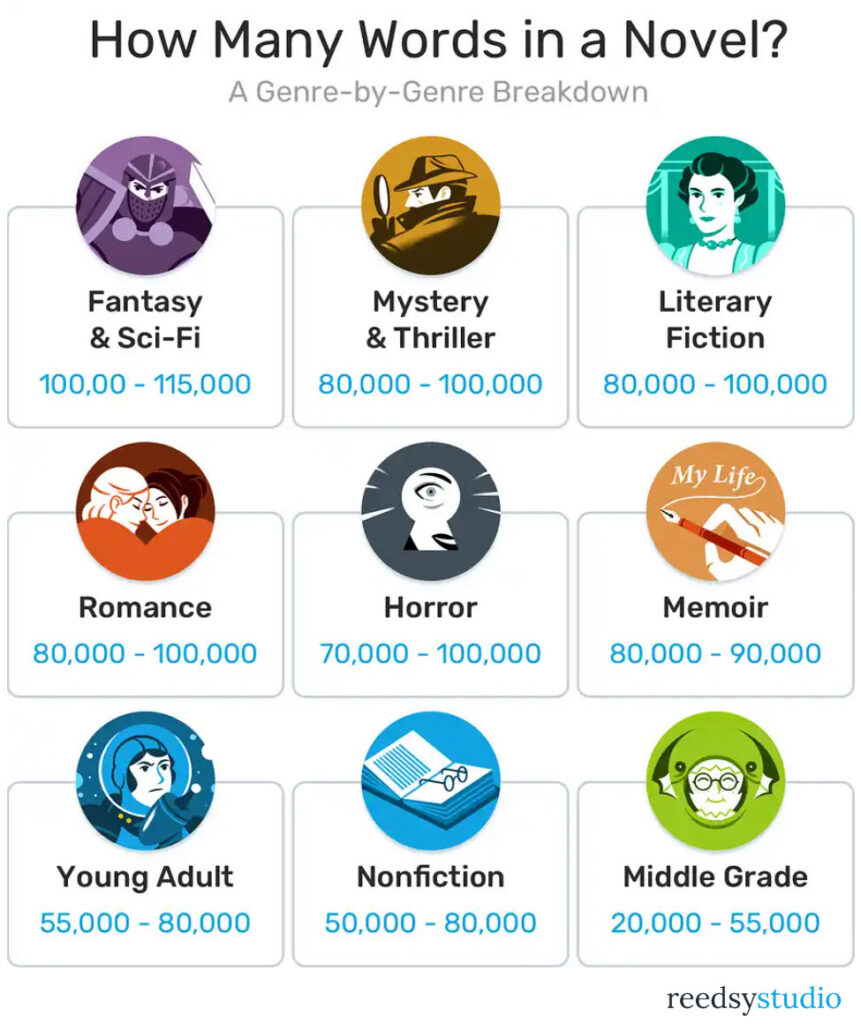
If you’re trying to meet a publisher’s required wordcount or the standard for your chosen genre, here are some ways to make your book longer.
For nonfiction books, consider adding:
Illustrations
Charts & diagrams
Case studies
Visual examples
Checklists
Callouts & quotes
Definitions or glossary
Exercises
For novels, consider:
Expanding key moments by going deeper (but not fluffing it up)
– Increasing character development
– Adding scenes & chapters to extend journey
– Adding backstory
– Adding supporting characters & subplots to strengthen your primary theme
– Adding supplemental content as front matter or back matter, such as maps and history
This issue came up on the The Author Guild’s forum recently, where an author was trying to figure out what to do with the 40,000-word fantasy novella they’d written. One of the suggestions was to pair the novella with another related novella, or with a selection of related novelettes and short stories.
The impact of self-publishing and ebooks on book lengths
Traditional publishers don’t like to publish novellas because they take nearly as much editing and design work as a full-length novel. This is despite the fact that most consumers don’t mind shorter novels.
Any stigma there was around shorter books has also been lessened by ebooks. When consumers aren’t picking a book off a shelf, they’re far less aware of the length of the book.
Both of those factors means there’s a growing market for novellas and other shorter books, but that market is largely the domain of self-publishers.
Writing a book is a major accomplishment that few people can claim. Taking the next step and trad publishing or self-publishing is an even bigger accomplishment, because so much more is required. It’s a long, long road that can take many years to traverse.
Bird by bird
Building the confidence that you can complete such a long journey is step one. When I wrote my first nonfiction book, Email Marketing Rules (1st edition), I’d already written more than a thousand articles and blog posts. It was no coincidence that I modelled that first edition after Michael Pollan’s Food Rules, which is essentially a collection of short blog posts.
I knew I could write what turned out to be 108 rules and put a nice wrapper on it, because I’d already written 10 times that number of articles. In fact, like many nonfiction authors, I mined some of those articles to create the content for the book. Beyond that, the challenge was how to organize the content into sections that created a logical flow from topic to topic. I spent more than a year collecting notes, and then an intense 3 or so months to write and edit it.
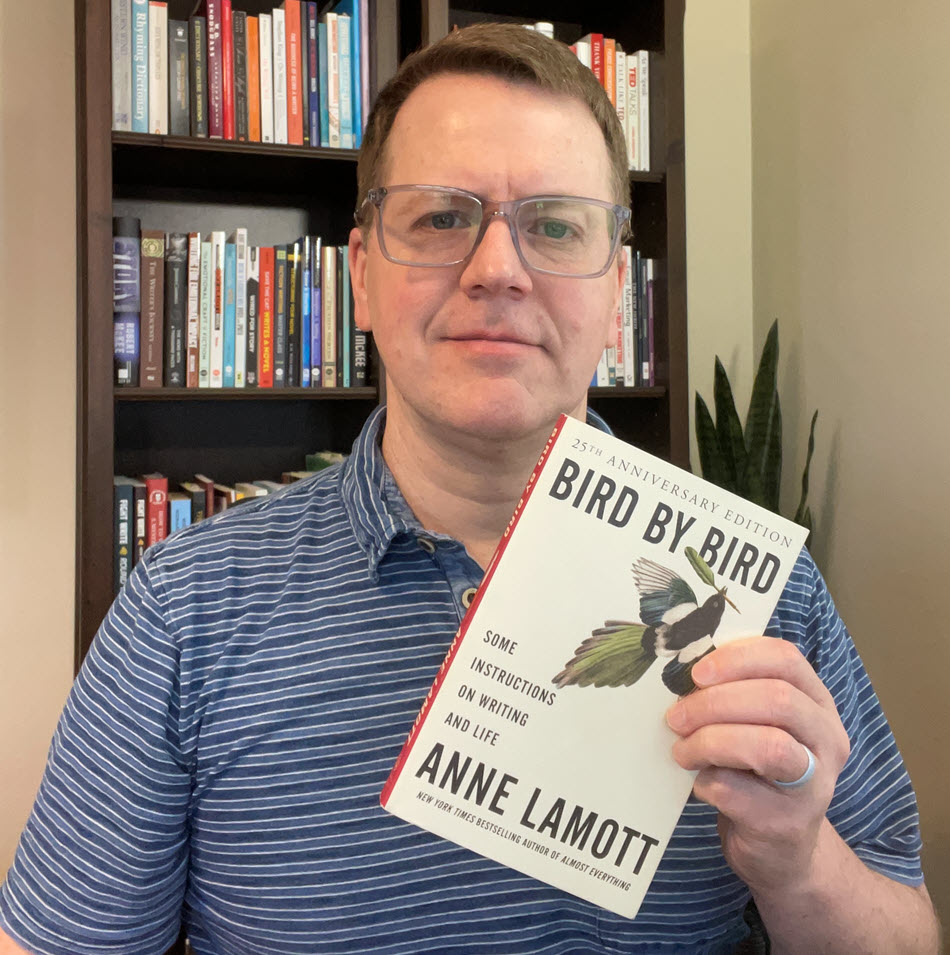
In Anne Lamott’s Bird by Bird, she talks about working your way through big projects bit by bit … or rather, bird by bird. That was absolutely my experience with all five of my nonfiction books. However, the experience with the two novels I’ve written so far was different.
Bird by Bird by Anne Lamott
Flight by flight
If I can expand on Lamott’s analogy, I wasn’t just describing each bird. I had to create several birds, harness them all, and fly them in different combinations from one place to another. And not just any place, but to pre-determined destinations.
Admittedly, in a number of cases, the birds took me to some places near where I’d planned to go, and often took detours or otherwise improvised. It turns out, directing a gaggle of birds is tough. They often have ideas of their own.
So, while writing nonfiction books first absolutely gave me the confidence I needed, novel-writing is nowhere near as straightforward. It’s no exaggeration to say that a novel involves a hundred times more variables and therefore decisions than a nonfiction book. For me, investing a lot of time in plotting was key, even if my birds introduced a bunch of wrinkles to the plot that I hadn’t planned from the beginning.
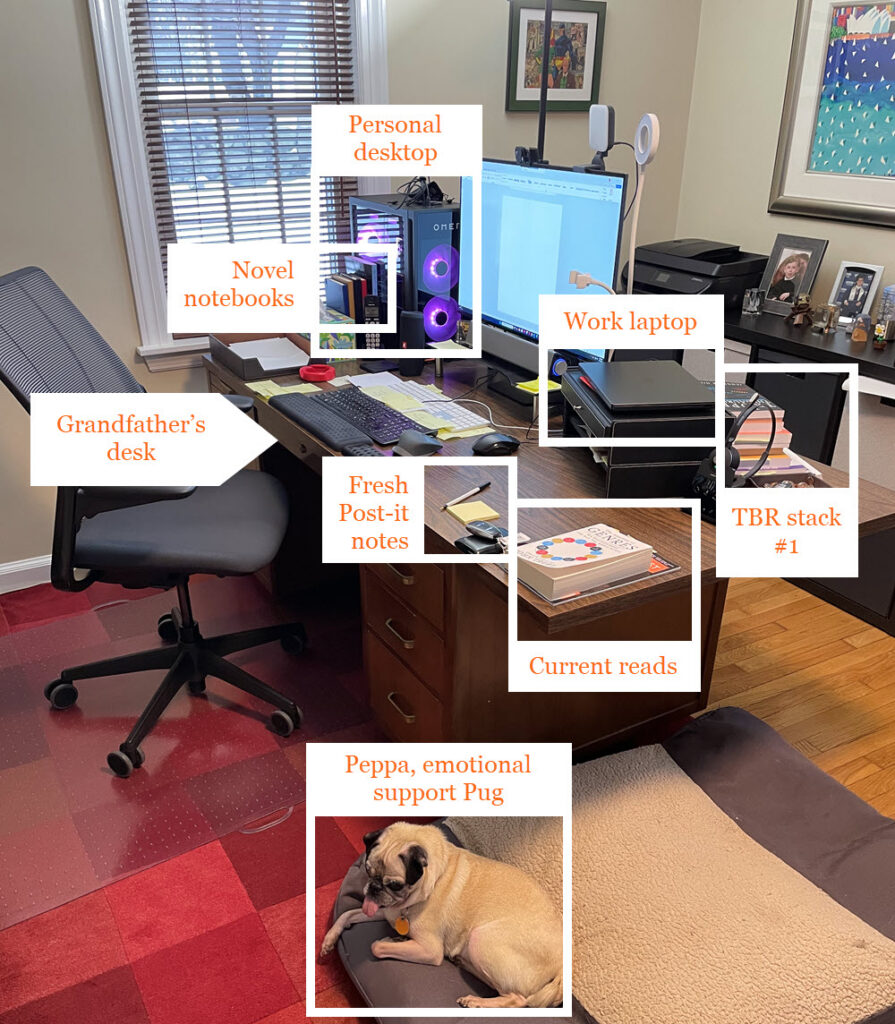
While I do a fair amount of notetaking in notebooks, my Notes app, and on Post-its, once I start writing and editing, I’m 100% at this desk, which used to be my grandfather’s. It was the desk he used while working at Tesoro, an oil company in San Antonio. The company gave it to him when he retired and it was in his study until he passed away when I was in high school. I always admired it and was able to convince my parents to give it to me when I moved to New York City for grad school.
It’s now home to many of my writing essentials, including my personal computer, which shares a 32-inch monitor with my work laptop; notebooks for each of in-progress novels and series; a fresh pack of Post-it notes; and my current reads pile and one of my TBR piles. As you’ve seen in my videos, my bookcase of novel-writing books is behind my chair. Oh, and I have a big fluffy bed tucked under the edge of my desk for Peppa, our pug. (And yes, she derps all the time, even when she’s sleeping.)
On some level, I’m envious of folks who can write on their back porch or in a coffee shop, but I need consistency and quiet. I can’t see that ever changing.