Why I self-published my nonfiction books

Honestly, I didn’t give much thought to trying to get my nonfiction books traditionally published. Here’s why I self-published:

  • I’d worked at two book publishers, Texas A&M University Press and Marlowe & Co., so I was familiar with the publishing process.
  • I knew platform size is the primary determinant of nonfiction book success and that I already had a solid platform.
  • As a former managing editor at a magazine, I was confident in my page layout skills.
  • I knew Amazon had 70% of the book market, so being present in that one store would give me exposure to the majority of book buyers. (That made publishing through KDP a no-brainer.)
  • I knew self-publishing would be much faster.
  • I also knew I’d have much more control and already had a clear vision for the book.

Thankfully, all of those things turned out to be true. In less than a year, I was able to write the 214-page first edition of Email Marketing Rules, have it edited by some of my trusted industry friends, get it professionally copyedited, and publish it.

But there were additional benefits of self-publishing I didn’t realize until later. For example, a traditional publisher would have never allowed me to publish a 322-page second edition 18 months after the first edition. And they definitely wouldn’t have allowed me to publish a 677-page two-volume fourth edition.

Did all of those decisions maximize profitability? I’m sure they didn’t. But I don’t regret any of them, because those decisions capitalized on my excitement and allowed me to create books I’ve always been proud to put my name on.  

Self-publishing gives you lots of control. Make sure you’re using it to maximize your vision.

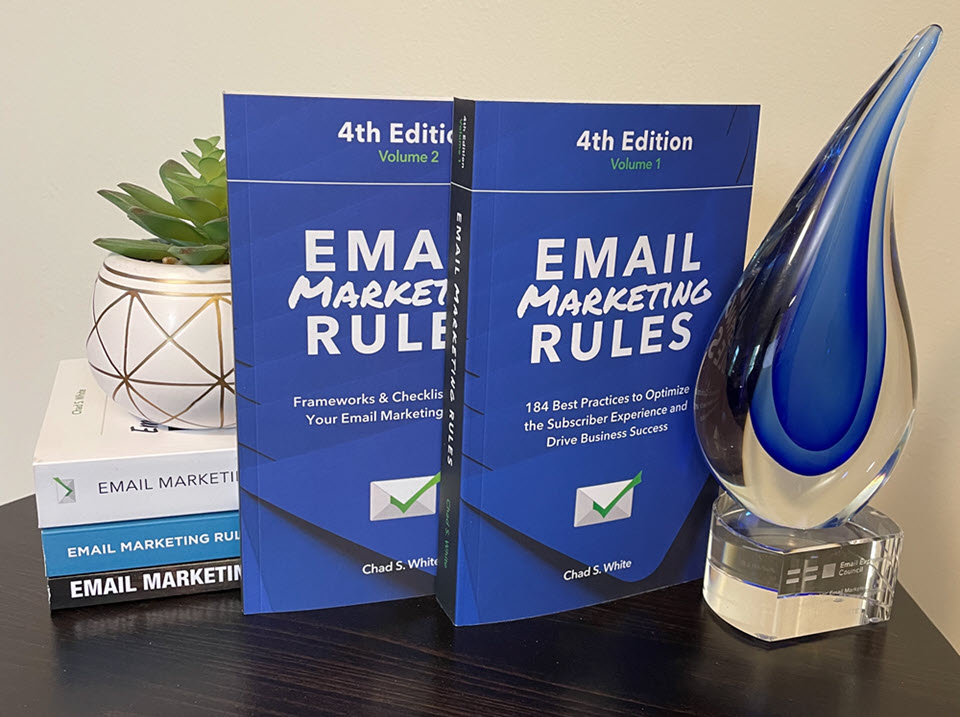
All four editions of 'Email Marketing Rules' by Chad S. White
All four editions of Email Marketing Rules

To receive future posts or to become a Patron and support my dystopian sci-fi novel and get special thank-you goodies upon its publication, subscribe on Substack →

When Novels Mattered: A misread on what’s changed in the world of literature

David Brooks’ New York Times article When Novels Mattered (link to gift article) is the latest salvo against the declining relevance of fiction, and in particular literary fiction. He blames this decline on the popularity of genre fiction, the rise of the internet, M.F.A. programs, and ultimately (and predictably) on liberal politics. My two cents is that only one of those events had a significant impact on shaping the current literary marketplace.

The internet-driven collapse of the monoculture

In the mid- to late 20th century that Brooks idealizes, media was tightly controlled by a relatively small number of institutional players. And then came the internet. Web 1.0 shook the monoculture, but Web 2.0 destroyed it.

Streaming completely undid TV, which also competes with YouTube and TikTok. What remains of radio competes with streaming services and podcasts. News organizations compete with individuals and corporations and social media at large—a transition I have witnessed and experienced first hand as a journalist, then blogger, and then brand journalist and content marketer. And, of course, traditional book publishers now compete with self-publishing—another anti-establishment trend I have happily participated in. Because of their tremendous costs, movies are the last bastion of monoculture (which is why we’re seeing yet another Superman).

The consequence of all this new competition is that there are far fewer mega-hits in every medium, not just in books. At the same time, our culture is much richer and much more representative than it was 40 years ago. The democratization of media has been a wonderful thing. The pie is not only bigger, but way more people have gotten a slice of it. That’s good for creators and even better for consumers.


To receive future posts or to become a Patron and support my dystopian sci-fi novel and get special thank-you goodies upon its publication, subscribe on Substack →