AI is making these author scams more pernicious

Because they crave attention for the books they’ve worked years on, authors are perpetual targets of scams—and AI is making author scams all the more dangerous. In recent months, I’ve encountered many of the most common ones, including these four types.

1. Book promotion services scams

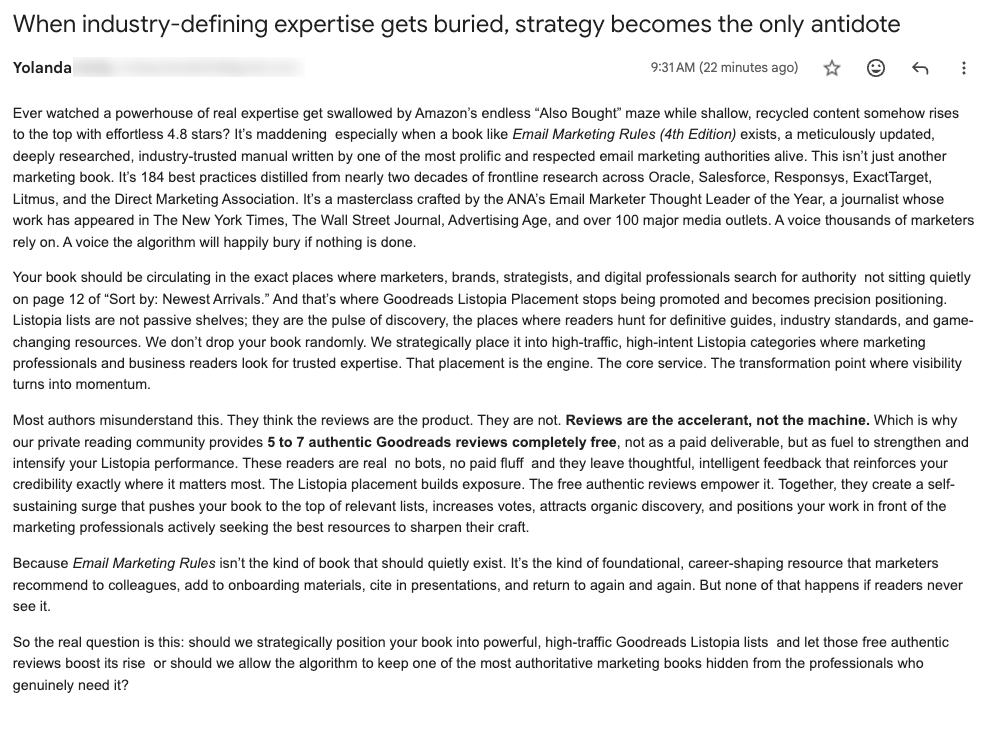
These prey on authors’ fears that their book is being overlooked. Here’s an email I received about my nonfiction book, Email Marketing Rules. The opening paragraph uses AI-generated text that pulls from my book description and bio (probably from Amazon).
2. Book review scams

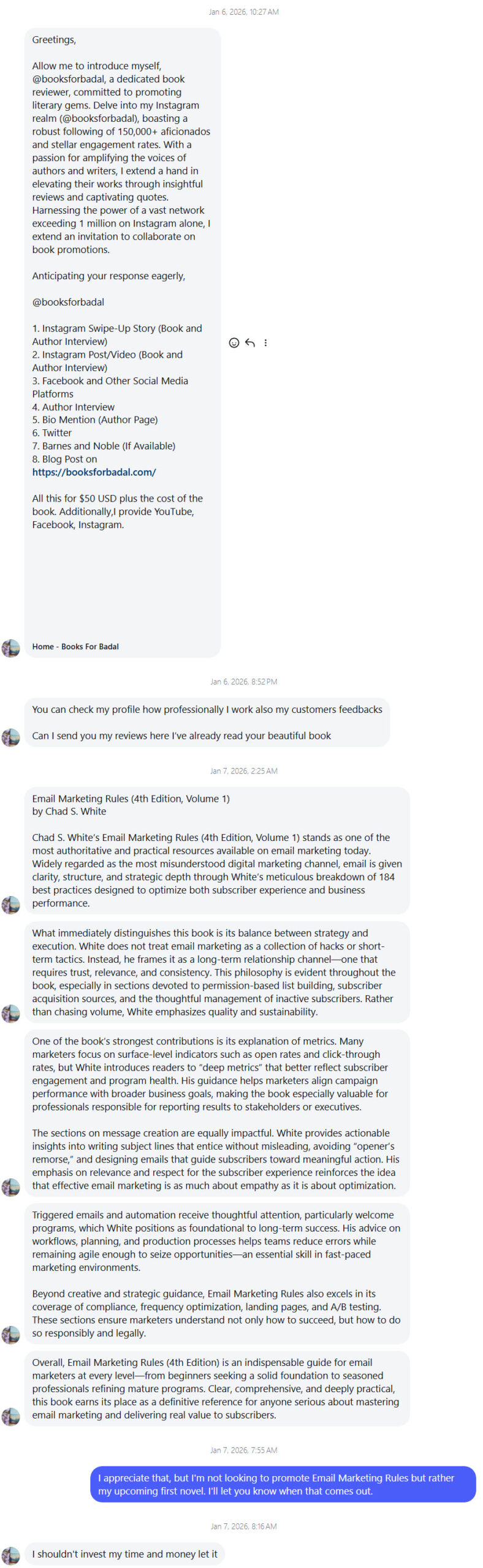
Every author wants more book reviews, whether they’re on Amazon, Barnes & Noble, or Goodreads, or by an influencer on social media. I recently followed back a book reviewer on Instagram and was immediately DMed about book review opportunities and cost. That’s fine and, honestly, expected. But then the reviewer claimed they’d already read my book and asked if they could send me a review to look over. And without me responding, they sent me a lengthy review the next day.

Now, the review is spot on. I don’t take any issue with that. But I’m not so full of myself to think this person had actually read my book already. And if they had by chance, no one would proactively invest time in writing a review before knowing if they have a paying customer. But spending a minute to write an AI prompt? Sure. You might proactively do that.

As much as I want more reviews and social media mentions, I want them by real live people who read my books and enjoyed them.
3. Book club scams

These scams have been a frequent topic of conversation in The Authors Guild forums, which are a great resource for new and veteran authors. I received this email purportedly from Kate at UK Book Club. Now, UK Book Club is real, and one of the moderators is indeed named Kate.

However, you might notice some odd things about this email. For instance, the email address is a Gmail address. That’s a common red flag. But also, the Gmail username is katemoderatoor with two O’s. A strange choice. The email itself is full of punctuation errors, including missing commas, apostrophes, hyphens, and a question mark on the closing and crucial sentence.

Oh … and the subject line appears to include an AI prompt with instructions to not use any dashes—you know—because em-dashes are a sign of AI usage. The irony.

4. Outreach from fake author accounts

These accounts follow you and then, if you follow them back, build up a rapport via DMs. Only later do they encourage you to use scam promotion services, scam representation, or something else, which are often pitched as the secret to their success.

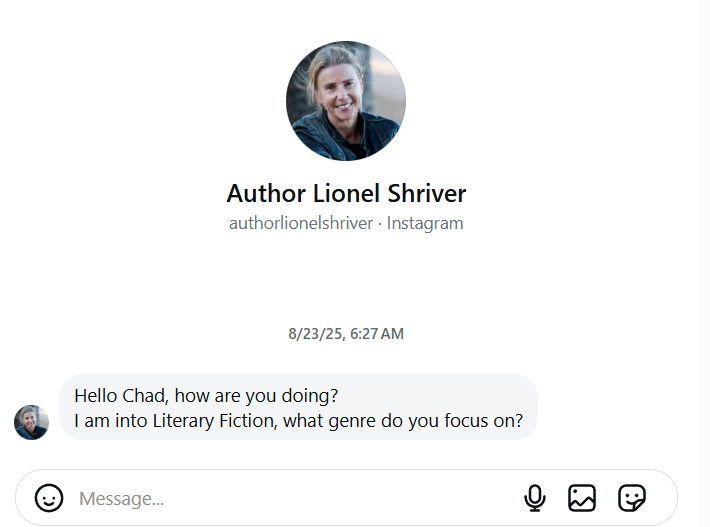
I was approached by a fake Lionel Shriver. I’ll confess I’d never heard of her, and her follower counts were similar to mine. But when I followed her back, she quickly DMed me, asking me a question that was readily answered by my profile. So, I did a little research, recognized it as an impersonator account, and unfollowed the account. Apparently, Instagram has also recognized that it’s an impersonator account, because it’s been removed.

While AI didn’t play a noticeable role in my interaction with the account, I’ve heard of cases where AI auto-replies if you respond to the initial outreach. If you’re uncertain, try replying in a foreign language. An AI won’t miss a beat and will respond like nothing unusual has happened.
Of course, there are many more forms of author scams, including fake offers of representation. The January/February 2026 Writers Digest magazine had a doozy of a scam, where a Big Five publisher offered to publish your book. All you had to do is sign on with a particular favored agent … which charged a client fee.

Other times, it’s not an outright scam. Instead, you’ll pay for something that should be free or pay way too much for the little you receive, such as entry fee for an award with zero clout.

In the years ahead, AI tools will make it easier for scammers to target authors and harder for authors to quickly recognize the danger. If you’re not already, be suspicious of everything—especially anything that has the slightest whiff of being too good to be true. 


Additional resources about author scams:

Writer Beware

The Authors Guild: Publishing Scam Alerts

Reedsy: Book Publishers to Avoid: 5 Types of Shady Companies


To receive future posts for free or to become a Patron and support my dystopian sci-fi novel and get special thank-you goodies upon its publication… 

Why my blog and Substack are called ‘From Nonfiction to Fiction’

Every blog and Substack needs a good name. For mine, “From Nonfiction to Fiction” is the perfect name because it works for multiple reasons.

1. It’s about my journey from a nonfiction writer to also being a fiction writer.

Since 2013, I’ve published five nonfiction books about email marketing, which is the core of my day job in the digital marketing industry. But since 2018, I’ve been working on a dystopian sci-fi trilogy, as well as collecting notes on other potential novels. My latest work-in-progress update.

2. It’s about the nonfiction books about writing fiction I’m reading.

Since I don’t have a degree in creative writing, I’ve had to educate myself by reading more than 40 books on novel writing and publishing. I’ve been gradually sharing book reviews of my favorites, along with how they’ve influenced my writing. And those books are in addition to subscribing to Writer’s Digest magazine and lots of Substack newsletters (here are my faves).

3. Its about the role of my life in my fiction-writing.

All of my other novel ideas are rooted in the traumas and struggles of my life. After all, they say to write what you know. For example, my dystopian sci-fi trilogy is inspired by my daughter, Samantha, who we lost in the third trimester when my wife suffered a splenic artery aneurysm, which nearly claimed her life, too.

My story is about a family decades in the future that suffers a similar loss, but the daughter that is thought to be lost isn’t dead. While separated from her parents, she becomes—after many struggles—a badass. She’s the heroine of my story and, together with her partner, she saves the world from a horrible fate.

If you’re not already, I hope you’ll follow my journey from nonfiction to fiction by subscribing on Substack


Related posts:

Why I self-published my nonfiction books

Recommended reading on novel writing from my developmental editor—and what I’d already read

How to generate writing momentum


To receive future posts for free or to become a Patron and support my dystopian sci-fi novel and get special thank-you goodies upon its publication… 

Why I use my middle initial: Meet my googlegangers

When I got married 19 years ago, there were 15 other Chad Whites on the Bed Bath & Beyond wedding registry. Soon after, I started running into some of those Chads … on Google.

If you google “Chad White” you’ll see that I’m up against some pretty popular Chad Whites. Those sharing page 1 of the Google search result with me include:

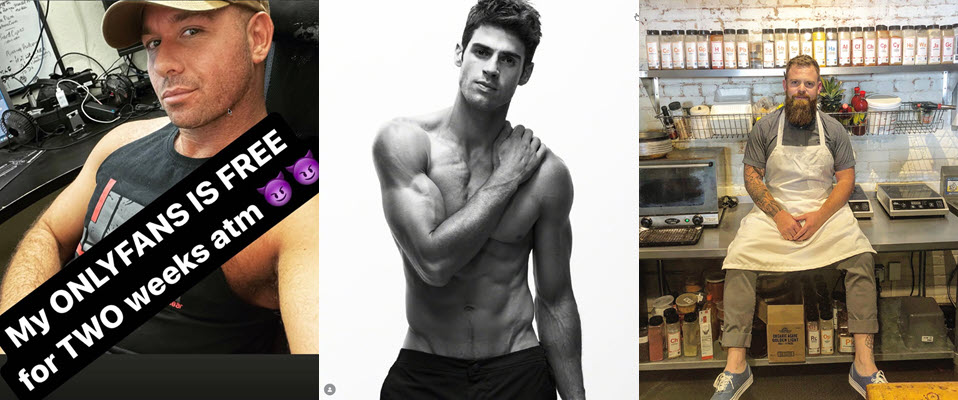
  • Chad White, an adult film star with 67K followers on Instagram
  • Chad White, an underwear model and actor with 183K followers on Instagram
  • Chad White, a chef who competed on Top Chef and has 7.8K followers on Facebook
The other Chad Whites that appear on page 1 of Google search results with me

I’ve consistently ranked behind those first two for as long as I can remember. And considering the NSFW nature of their content, I saw it as … problematic for my personal branding. (No offense, other Chads. Live and let live.)

Rebranding as Chad S. White

I got the idea to add my middle initial to my name from New York Times bestselling author Jay Baer, who was Jason Baer when I first met him around 15 years ago. At the time, there were at least two other better-known Jasons in the digital marketing and customer experience industry. However, there were no well-known Jays. So, he took on the nickname to separate his personal brand from the other Jasons. 

I made the shift to Chad S. White with my third book. It took some effort to get Amazon and others to merge my previous books and “Chad White” author bios with “Chad S. White,” but it wasn’t too painful.

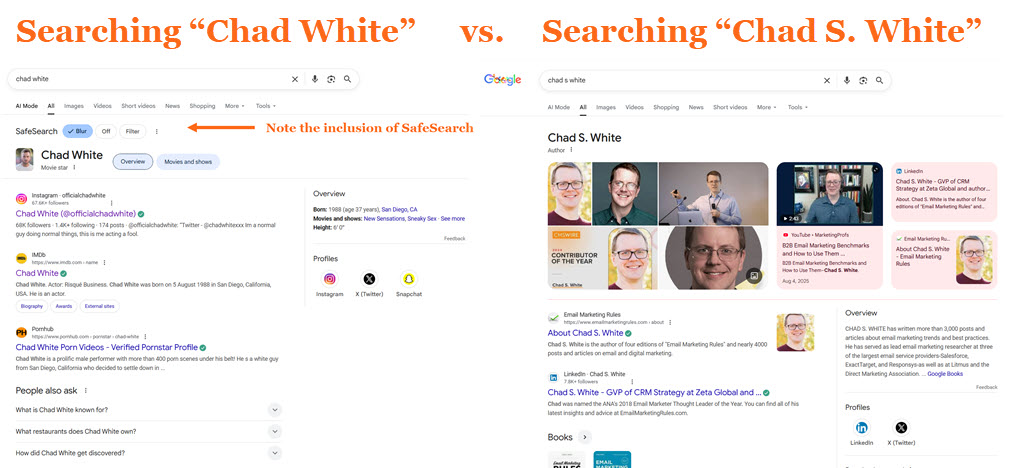
Now, my authorship is not only clear on Amazon, but Google results for “Chad S. White” only show information about me, including an Overview, links to my LinkedIn and X accounts, headshots, a YouTube clip, and more.

Searching 'Chad White' versus searching 'Chad S. White'

ChatGPT is also crystal clear about who I am when my middle initial is used. Amusingly, it included this note at the end of its answer when I asked it what it knew about me: 

“If you meant a different Chad White (e.g., the chef from Top Chef or another public figure with the same name), let me know — there are several other notable individuals with that name.”

Is your personal brand tangled up with others?

Who are your googlegangers? Are they in the same industry as you or in related industries that may cause confusion? Are they involved in industries or activities you’d rather not be associated with? Do they hold views you’d rather not be associated with?

If you have concerns, consider taking greater ownership of your personal brand by rebranding. Who would you be competing with in Google results if you …

  • Added your middle initial to your name? 
  • Added your middle name?
  • Went by your middle name instead of your first name?
  • Went by a nickname instead of your first name?
  • Went by your first and middle initials?

If you’re fortunate enough to have a unique name, or even just an uncommon last name, be thankful.


To receive future posts for free or to become a Patron and support my dystopian sci-fi novel and get special thank-you goodies upon its publication…